



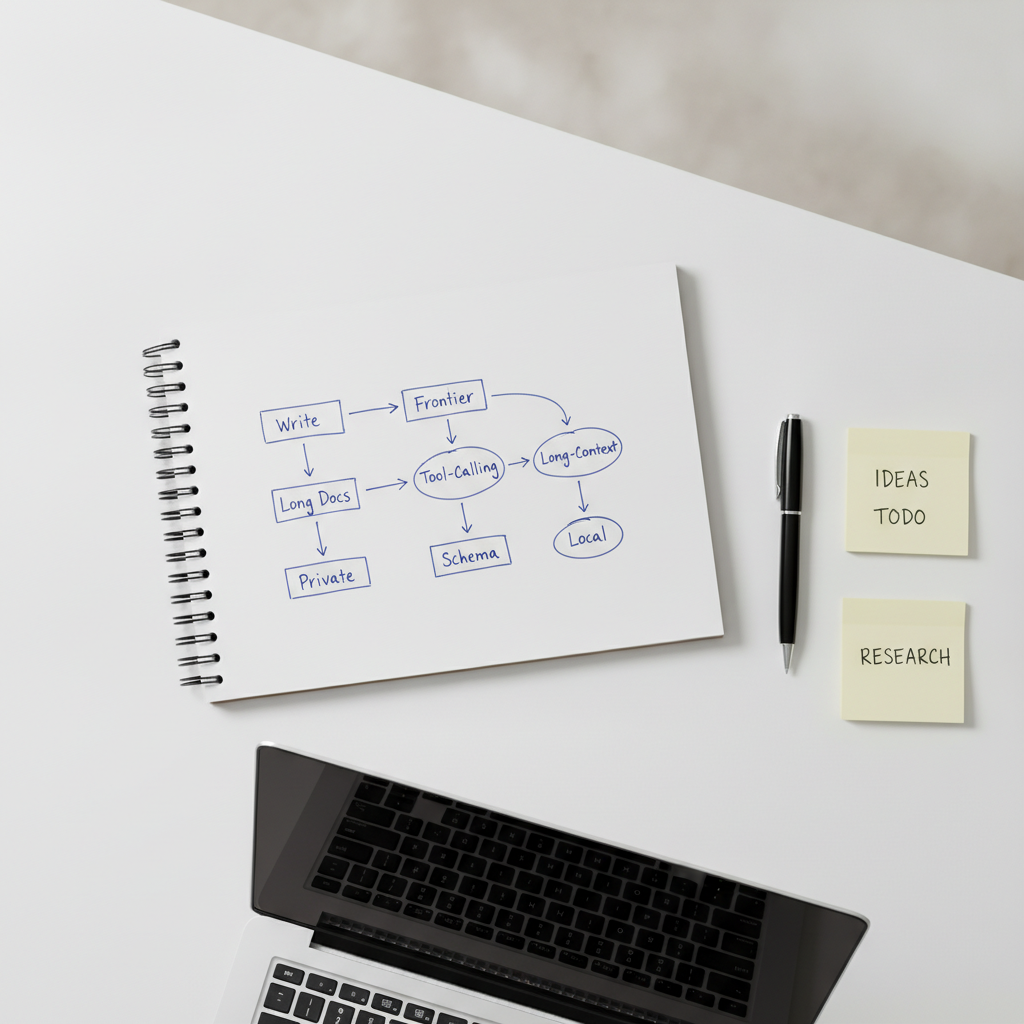
Picking the right AI is half the result and most of the cost. Here’s a fast, vendor-agnostic model picker you can apply today—plus rules to avoid overkill.
Further reading: Simon Willison’s practical take on this topic is a great companion: An opinionated guide to which AI to use to do stuff.
Quick model picker (what to use for common jobs)
- Brainstorming, outlining, and general writing: Use a strong, general chat model. Examples: Claude 3.5 Sonnet, GPT-4o, Gemini 1.5 Pro. Tip: ask for 3 outlines first, then expand one.
- Code assistance and tool use: Pick models with reliable function calling and structured output support. Examples: GPT-4o/4o-mini, Claude 3.5 Sonnet with tool use. Tip: return JSON that matches a provided schema.
- Long PDFs, transcripts, or many files: Choose long-context models. Examples: Gemini 1.5 Pro (very long context), Claude 3.5 Sonnet (long context). Tip: supply a short task brief up front (“You are reading for X”).
- Data extraction to CSV/JSON: Use cost-efficient models with schema constraints. Few-shot with 3-5 labeled rows, require valid JSON, and reject partial matches.
- Private/offline or air‑gapped: Run local models. Examples: Llama 3.1 8B/70B, Mistral 7B, Phi-3 via Ollama or LM Studio. Tip: add retrieval/RAG for accuracy instead of chasing larger weights.
- Images, charts, or screenshots: Use multimodal models. Examples: GPT-4o, Gemini 1.5, Claude 3.5 with Vision. Tip: ask for a reasoning chain but only output the final answer.
- Agents and automations: Keep tools narrow (search, retrieve, write file, call API). Add guardrails, timeouts, and a “stop and ask” step for expensive actions.
Rules of thumb that save time and money
- Start cheap, escalate only if needed. Try a small or “mini” model first; upgrade when quality blocks progress.
- Constrain outputs. Use JSON schemas, regex patterns, or XML tags to reduce cleanup and re-runs.
- Prefer retrieval over guessing. Pipe trusted snippets into the prompt and cite them in outputs.
- Batch and cache. Reuse system prompts, stream tokens for UX, and batch tasks to cut latency and cost.
- Evaluate continuously. Keep a small eval set, log failures, A/B models occasionally, and watch for regressions.
Sources and tools to check before you choose
- Independent head-to-heads: LMSYS Chatbot Arena Leaderboard shows how models rank via blind voting.
- Vendor model pages: See latest capabilities and limits for OpenAI models and Anthropic Claude 3.5 Sonnet.
Takeaway
Match the job to the model class: frontier chat for open‑ended tasks, long‑context for big docs, schema‑first for extraction, multimodal for images, and local for privacy.
Spend less by defaulting to smaller models, adding retrieval, and constraining outputs—then scale up only when the work demands it.
Get one actionable AI nugget in your inbox each week. Subscribe to our newsletter.
