



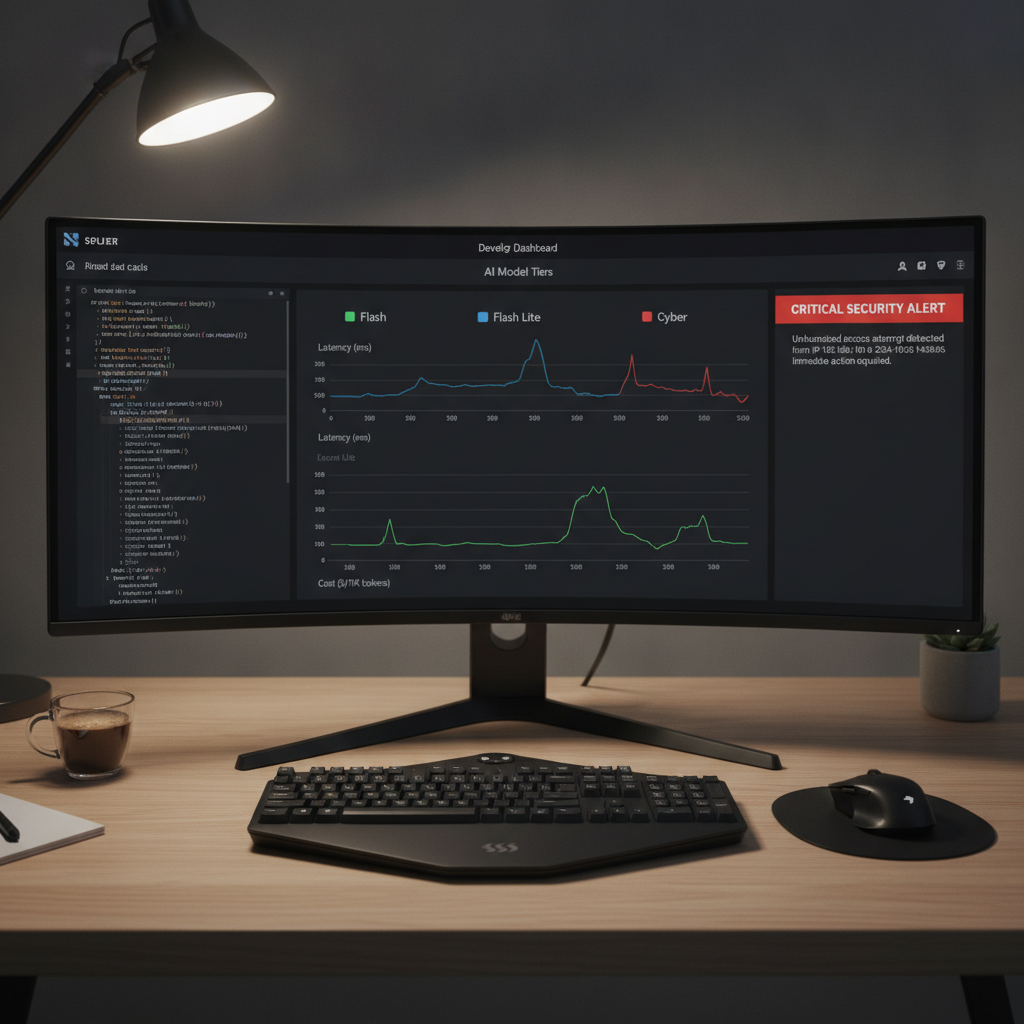
Google DeepMind just introduced Gemini 3.6 Flash, 3.5 Flash Lite, and 3.5 Flash Cyber. Here’s a no-fluff plan to turn the announcement into working product decisions this week.
Source: Google DeepMind’s announcement.
What this announcement signals
- Latency and cost are first-class: “Flash” lines typically target faster, cheaper inference for high-traffic apps.
- Right-sized models matter: Multiple tiers suggest a push to fit workloads from ultra-light tasks to specialized domains.
- Specialization is rising: A “Cyber” variant implies security-focused use cases with guardrails and human review.
- Platform maturity: Expect improved tooling, eval guidance, and integration paths alongside the models.
When to use which model family
- Gemini 3.6 Flash: Real-time UX, agents making many small calls, streaming responses, and high-concurrency APIs where latency spikes hurt conversions.
- Gemini 3.5 Flash Lite: Ultra-low-cost automations, batch labeling, enrichment, or simple classification/routing where “good enough” beats “best.”
- Gemini 3.5 Flash Cyber: Security workflows (triage, summarizing findings, rule suggestions). Keep a human-in-the-loop and never rely on a single-model verdict for blocking actions.
A 30-minute evaluation checklist
- Define 3 tasks: one core path (e.g., assist, classify), one edge case, one safety-sensitive scenario.
- Pick a tiny dataset: 20–50 real samples that reflect production complexity; anonymize any PII.
- Set success metrics: latency budget, cost per call, task accuracy/acceptance thresholds.
- Run a baseline: Compare each Gemini tier to your current model or a simple rules baseline.
- Measure: Record p50/p95 latency, token usage (or request units), and error types; visualize deltas.
- Probe safety: Red-team with known traps (prompt injection, jailbreaks, toxic content) and document failure modes. See OWASP Top 10 for LLM Apps.
- Benchmark references: Cross-check task framing with public suites like Stanford HELM to sanity-check coverage.
- Decide: Choose the smallest/cheapest tier that meets thresholds; document a fallback model.
Integration tips to ship this week
- Stream responses for chat/assistants to mask latency and improve perceived speed.
- Cache aggressively (semantic or exact) for repetitive prompts and system messages.
- Use tool/function calling to keep outputs structured; validate and sanitize before execution.
- Add circuit breakers: timeouts, retries with jitter, and a cheap fallback tier for spikes.
- Batch where possible for enrichment/jobs; monitor cost per thousand items, not per call.
- Log everything: prompts, parameters, token usage, and outcomes to feed evals and cost governance.
Risk and governance quick wins
- Data handling: Mask PII, set retention policies, and review vendor data-use terms before send.
- Prompt injection defense: Treat external content as untrusted; constrain tools; scrub instructions. Reference: OWASP LLM Top 10.
- Human-in-the-loop for security and compliance decisions; require multi-signal corroboration.
- Safety filters: Enable content filters for abuse, self-harm, and sensitive categories where available.
- Model monitoring: Track drift in accuracy, latency, and refusal rates; re-test after model updates.
- Audit trails: Keep immutable logs of prompts/outputs for investigations and regulatory needs.
Key takeaway
Use the smallest Gemini tier that meets your bar, add strict safety rails, and ship with streaming, caching, and fallbacks. Re-evaluate monthly as models evolve.
Like this? Get one practical AI nugget in your inbox each week. Subscribe to the newsletter.
