



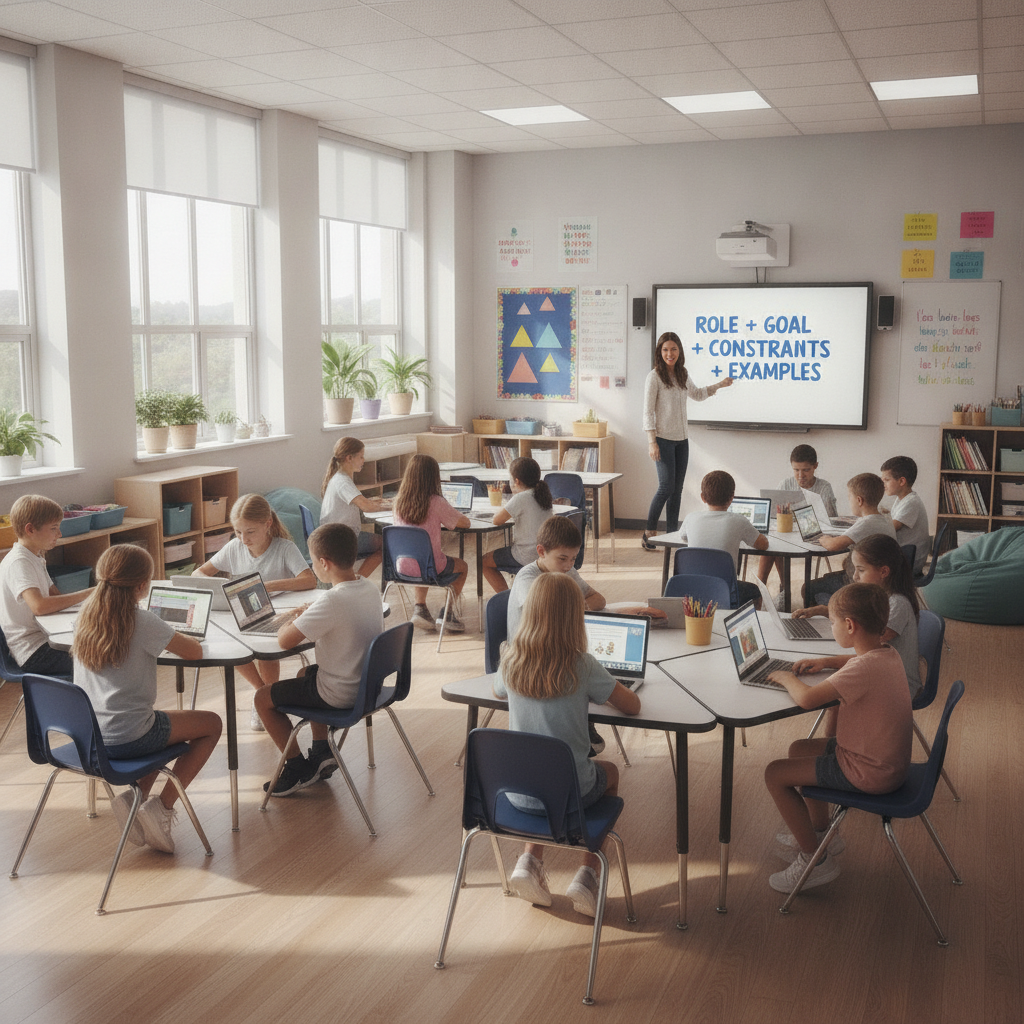
OpenAI’s new guide for teachers spotlights practical AI skills students can apply right now. Here’s a distilled, classroom-ready set you can roll out this week, inspired by OpenAI’s K‑12 educators resource.
The 5 practical AI skills to teach now
- Prompt patterns. Use a simple frame: role + goal + constraints + examples. Example: “You are a science coach. Goal: explain photosynthesis to 5th graders. Constraint: 150 words, plain English. Example: include one analogy.”
- Verify AI output. Have students run a three-step check: ask for sources, cross-check with a trusted site or textbook, and highlight any claims the model can’t verify. Teach them to accept “I don’t know” as a valid outcome.
- Bias and perspective checking. Ask, “Whose voice is this? What perspectives might be missing?” Practice reframing: “Rewrite from the perspective of a community historian,” or “List three alternative explanations.”
- Privacy-first habits. Never paste personally identifiable information (PII). Use school-approved accounts and discuss what data may be stored by tools. Practice “redaction” before sharing drafts with AI.
- Accessibility and differentiation. Show students how to adjust reading levels, generate bilingual summaries, and scaffold steps. Use AI to create hints, not answers.
Ready-to-use classroom prompts
- “Explain the water cycle for a 4th grader in 120 words. Use a kitchen analogy. Then list two sources I can check.”
- “Generate three practice math problems on fractions at beginner, intermediate, and advanced levels. Show solutions after I attempt each.”
- “Summarize this article at an 8th-grade reading level and flag any claims that need citation.”
- “Translate this paragraph to Spanish and provide a vocabulary list of 10 key terms with definitions.”
- “I’m studying the causes of the American Revolution. Give me two contrasting viewpoints and questions to probe each one.”
Policy and safety basics to model
- Disclosure by default. Require students to note if and how AI helped (e.g., brainstorming, outline, translation). Keep process notes or drafts as evidence of learning.
- Assessment design. Favor performance tasks, oral defenses, and process artifacts over reliance on AI-detector tools, which can be inaccurate. Grade the thinking, not just the final text.
- Age-appropriate use. Align tool access with school policy and parental guidance. Remind students: no PII, and when in doubt, ask an adult.
Why it matters
These skills reflect what students need to navigate AI confidently: clear prompts, critical verification, ethical awareness, and accessibility. They align with emerging guidance from UNESCO’s generative AI recommendations for education and the practical focus in OpenAI’s educator resource.
Takeaway
Make AI a literacy, not a shortcut. Teach students to prompt with structure, verify with sources, protect privacy, and use AI to support—not replace—thinking.
Enjoy nuggets like this? Subscribe to our weekly brief: theainuggets.com/newsletter.
