



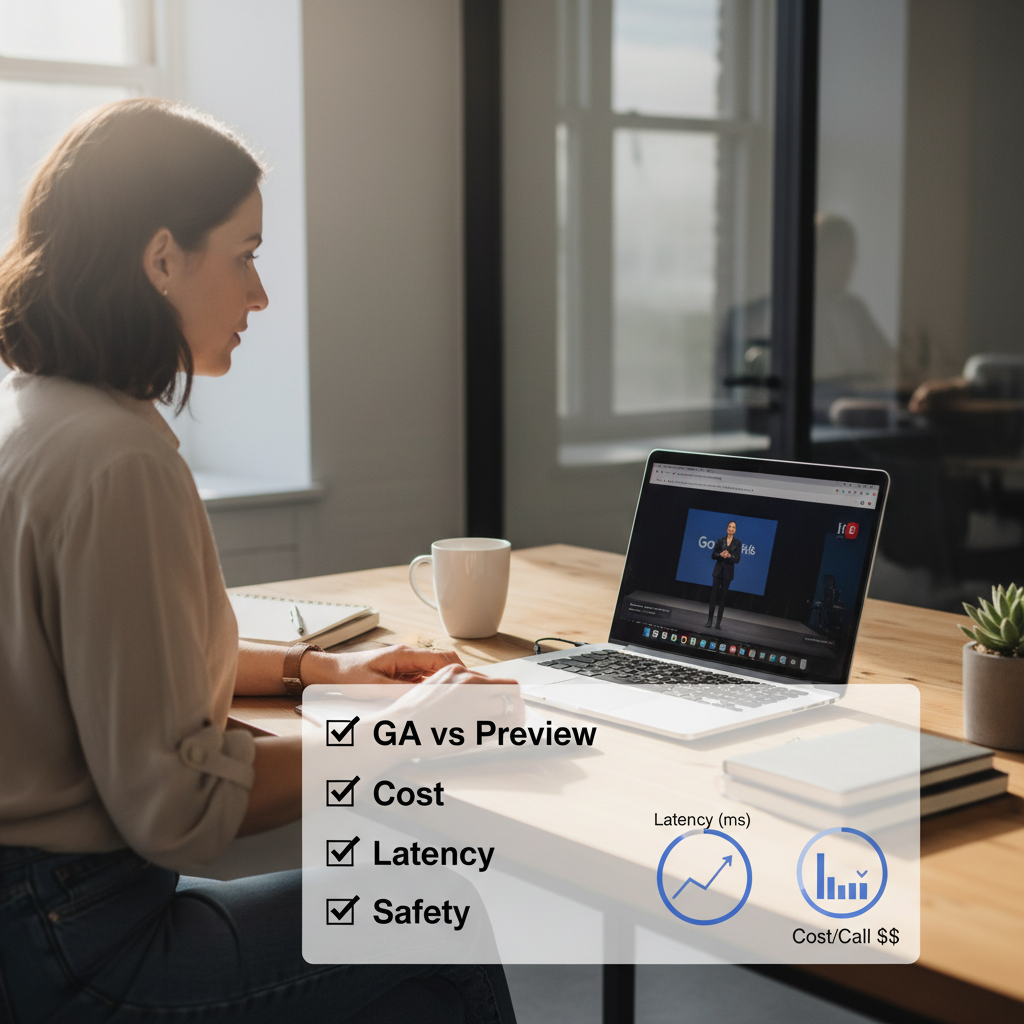
Big launches like Google I/O drop a firehose of AI updates. Here’s a 30-minute checklist to turn headlines into decisions you can ship—without drinking the hype.
For a curated, developer-friendly recap of I/O, Simon Willison’s field notes are a great navigator—skim them first, then run this playbook: Highlights from Google I/O (Simon Willison).
The 30-minute AI announcement triage
- 1) Scope the job-to-be-done (3 min): Write one sentence on the user problem this could improve—latency, accuracy, conversion, or cost. If you can’t name it, stop.
- 2) Status check (3 min): GA vs Preview vs Labs. Treat GA as eligible for prod pilots. Preview is for prototypes only. Labs is a watchlist item.
- 3) Cost and limits (5 min): Find pricing, quotas, regions, and token limits before you test. Reference: Vertex AI pricing.
- 4) Data & privacy (3 min): Confirm data retention, training usage, PII handling, and on-by-default logging. If unclear, assume “no” for regulated use cases.
- 5) 10‑minute smoke test (10 min): Hit one endpoint with a minimal prompt/task. Record latency (p50/p95), cost per call, and a single quality note (pass/fail).
- 6) Quality spot-check (3 min): Run 5–10 golden examples from your real workload. Track exact prompts, seeds, and versions so results are reproducible.
- 7) Safety & guardrails (2 min): Try your worst inputs. Note hallucinations, jailbreak sensitivity, and whether built-in safety filters degrade useful output.
- 8) Integration fit (3 min): List SDKs/APIs, rate limits, streaming needs, and fallback paths. If you can’t fail safe, don’t ship.
- 9) Open alternative (3 min): Compare with a strong open model (e.g., Llama 3) for price/perf/latency trade-offs and on-prem options.
- 10) Decision memo (3 min): Choose Try Now, Park (revisit date), or Ignore. Capture risks, owners, and next milestone.
Copy-paste prompt to test any new model
System: “You are a careful assistant. If unsure, say so. Never invent facts.”
User: “Task: [your task]. Input: [example]. Constraints: 100 words, cite sources if used. Output schema: {answer, confidence: 0–1, sources: []}. Quality rubric: factuality & actionability. If missing info, list what you need.”
Run this across 5 real inputs. Track latency, total tokens, and errors. Keep prompts, seeds, and model versions in version control.
Red flags that save you weeks
- Missing or shifting pricing/quotas
- No tokenization details or context window claims without docs
- Tiny rate limits that break your traffic patterns
- Benchmarks without datasets or eval code
- Sticky data retention or unclear training usage
- “Magic demo” features with no API/SDK or region availability
Why Simon’s recaps help
Simon Willison’s I/O notes are quick to scan and packed with primary links to demos, docs, and caveats—ideal for prioritizing what to test first. Start here: his I/O highlights.
Takeaway
Announce less, test more. A lightweight triage + a 10-minute smoke test turns splashy keynotes into grounded decisions that protect time, budget, and users.
Like this? Get one actionable AI nugget in your inbox each week: Subscribe to The AI Nuggets.
