



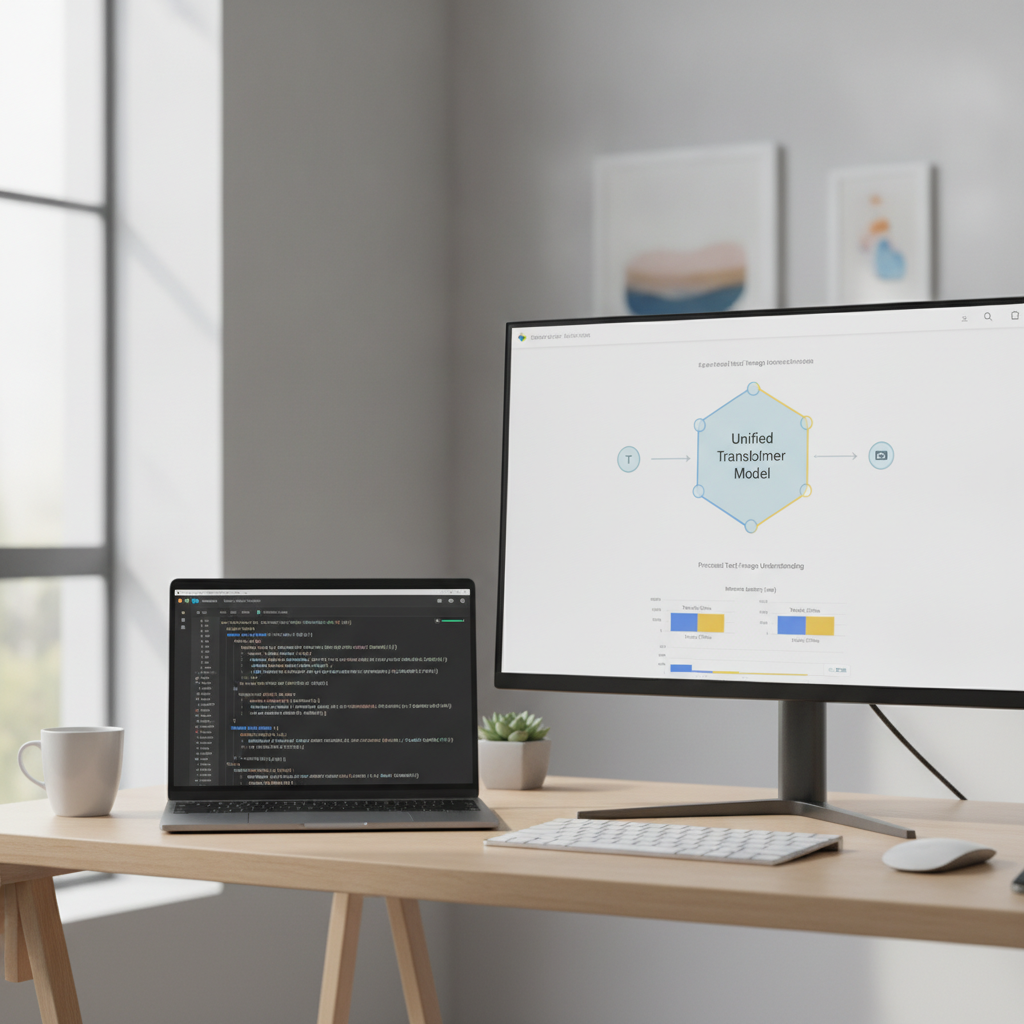
Google DeepMind just introduced Gemma 4 12B, a unified, encoder-free multimodal model for text + images. The big idea: one model handles both, cutting latency and infrastructure complexity. See the announcement: DeepMind.
For teams building vision-language apps—document Q&A, screenshot understanding, chart/diagram reasoning—this architecture could be the fastest path from prototype to production.
What “encoder‑free” means (in plain English)
Traditional VLMs bolt a separate vision encoder onto an LLM. Encoder‑free models feed visual tokens directly into the same transformer as text, simplifying the stack.
- One model to serve: fewer components, fewer failure points
- Lower end-to-end latency: no cross‑model handoff
- Simpler fine‑tuning: adapt a single backbone for your domain
- Unified token space: more consistent reasoning across text and images
- Potential cost savings: less GPU memory and orchestration overhead
Where Gemma 4 12B fits
- Document intelligence: OCR‑heavy PDFs, forms, invoices, slide decks
- Screenshot & UI analysis: QA, bug triage, accessibility checks
- Charts & diagrams: tables, plots, flowcharts, scientific figures
- Multimodal RAG: retrieve across text + images, then reason jointly
- Visual product search & enrichment: titles, attributes, compliance flags
Adoption checklist
- Scope tasks tightly: define input types (docs, screenshots, charts) and output formats
- Test latency early: batch size, image resolution, and context length drive cost
- Quantize carefully: 4–8 bit often keeps quality while fitting a single GPU
- Evaluate safety: add content filters; red‑team for hallucinations and visual misreads
- Verify licensing & usage: see Gemma documentation for terms, guidance, and best practices
Benchmarks and sources
DeepMind reports strong results for a 12B‑parameter model across key vision‑language tasks. Read the technical context and early evaluations in the official post: Introducing Gemma 4 12B.
For setup notes, safety guidance, and ecosystem tools, see the Gemma documentation.
Key takeaway
Encoder‑free multimodality trims stack complexity. If you need fast, productionable vision‑language features, Gemma 4 12B is a pragmatic default to evaluate first.
Get more like this
Enjoy quick, credible AI breakdowns? Subscribe to The AI Nuggets newsletter: theainuggets.com/newsletter.
