



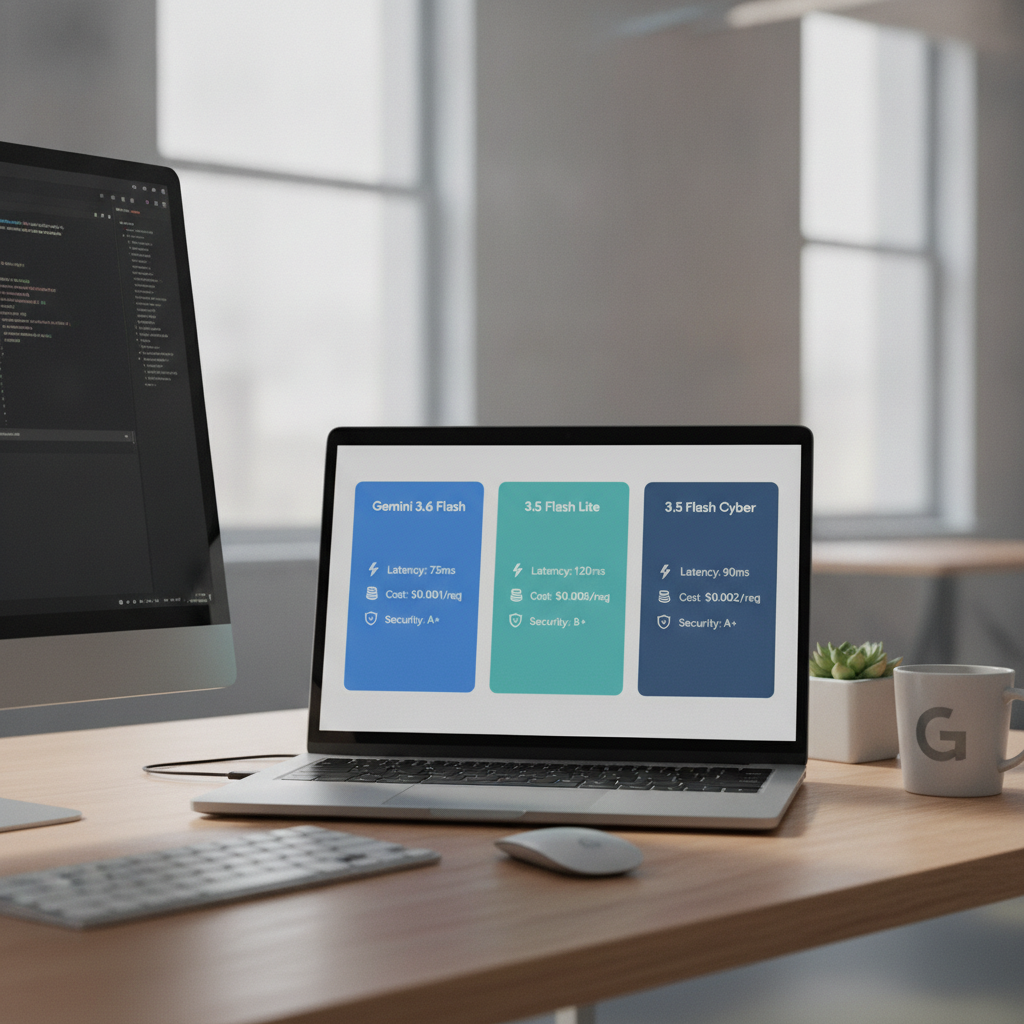
Google DeepMind just expanded the Gemini Flash family with three models: 3.6 Flash, 3.5 Flash Lite, and 3.5 Flash Cyber. Here’s the fast, practical breakdown—and how to pick the right one for your build.
Source: DeepMind announcement.
What’s new (in plain English)
- Gemini 3.6 Flash: Fast, cost-efficient, and solid for interactive apps. Best when you need low latency, high throughput, and strong multimodal support.
- Gemini 3.5 Flash Lite: A lighter, cheaper option aimed at simple tasks at scale—classification, tagging, short responses, and routing.
- Gemini 3.5 Flash Cyber: Security-tuned variant positioned for tasks like log triage, alert summarization, and code/security review assistance. Keep humans in the loop.
Where each model fits
- 3.6 Flash → Real-time chat, copilots, live agents, multimodal UI, rapid RAG responses.
- 3.5 Flash Lite → Bulk processing, tagging/metadata, content routing, lightweight on-device or edge prototypes.
- 3.5 Flash Cyber → Security operations center (SOC) helpers, log and alert summaries, guided code review, incident report drafting.
Quick decision guide
- Optimizing for the lowest cost and sub-second replies? Start with 3.5 Flash Lite. If quality isn’t sufficient, step up to 3.6 Flash.
- Handling security logs or triage? Trial 3.5 Flash Cyber. Add review workflows, redaction, and audit trails.
- Need multimodal support and steady throughput? Favor 3.6 Flash. Validate context limits and tool-use behavior in your environment.
- Follow a “smallest model that meets quality” rule to minimize spend and latency.
Practical tips to get started
You can prototype in AI Studio or deploy via managed services.
- Start in Google AI Studio (Gemini API) for quick prompt/eval loops; move to CI/CD once baselines are stable.
- Use structured outputs (JSON schemas) to cut parsing errors and reduce retries.
- Stream responses for better UX; cap tokens and temperature for predictable costs.
- Ground with retrieval for factual tasks; attach citations and track hit/miss rates.
- Build a small golden set and monitor regressions across model updates.
Risks and guardrails
- Hallucinations: Require citations for critical answers; enforce confidence thresholds.
- Security use cases: Keep human review, rate limits, redaction, and least-privilege access.
- Data privacy: Don’t send sensitive data without contractual and technical safeguards.
- Compliance: Log prompts/outputs, version prompts, and evaluate for bias/impact.
Takeaway
Think in tiers: Lite for volume and speed, Flash for real-time quality, Cyber for security-flavored workflows. Start small, measure, and scale what proves out.
Enjoying these bite-sized breakdowns? Subscribe to our newsletter for weekly, actionable AI nuggets: theainuggets.com/newsletter.
