



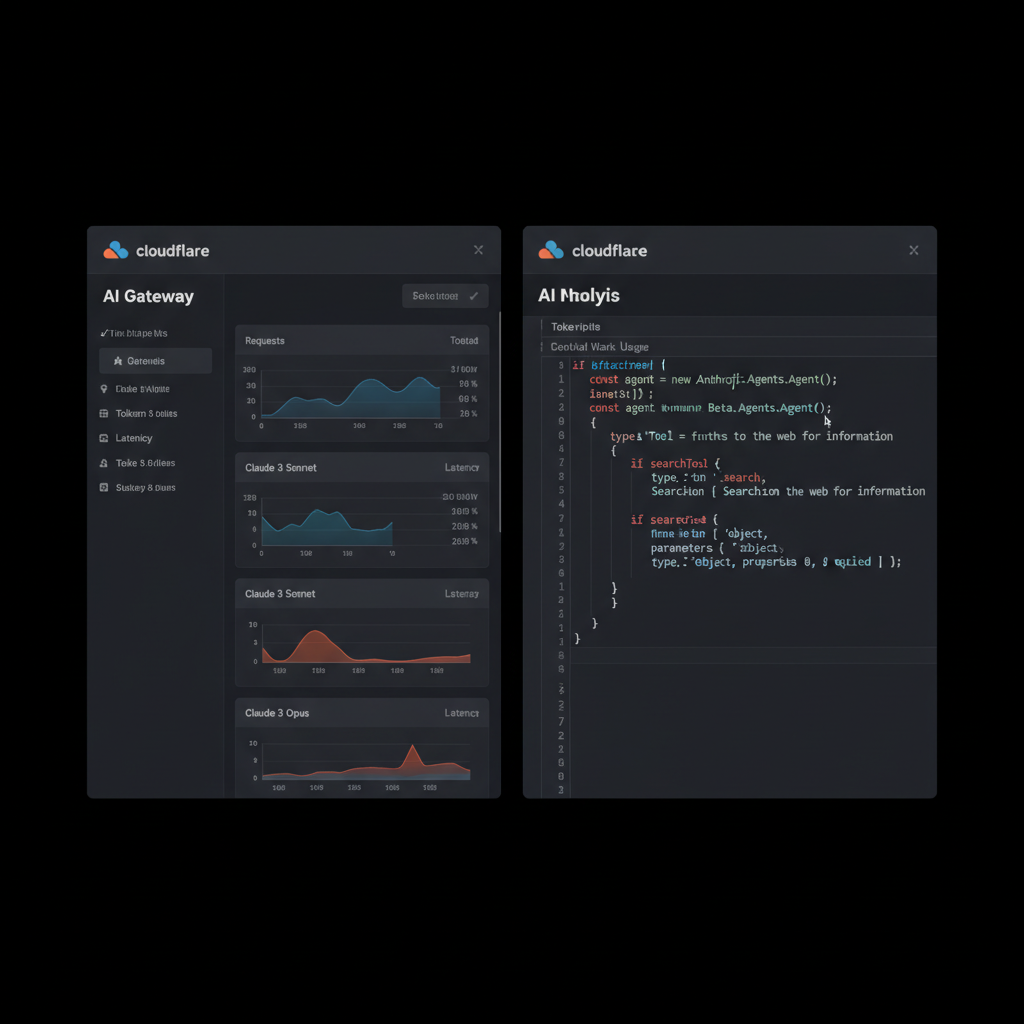
Cloudflare just outlined support for Claude managed agents—bringing agentic workflows, tool use, and observability closer to the edge. Here’s a concise guide to get from idea to production safely.
Source: Cloudflare announcement – Claude Managed Agents.
What this means
Managed agents let Claude plan, call tools, and maintain state across multi-step tasks. Running them on Cloudflare gives you global scale, programmable routing, secrets, caching, and detailed logging close to users.
Reference architecture on Cloudflare
- Entry point: Cloudflare Workers handles HTTP, auth, and request shaping.
- Agent core: Claude managed agent API orchestrates reasoning and tool use.
- Tooling layer: Worker-exposed tools (HTTP calls, DB ops, search, payments) with strict JSON schemas.
- State and memory: Durable Objects or KV for session state; Vectorize/R2 for knowledge and files.
- Observability: AI Gateway for usage analytics, latency, caching, and redaction.
- Controls: Turnstile, Rate Limiting, and WAF for abuse prevention.
Quick setup checklist
- Secure secrets: Store Anthropic keys and third‑party credentials using Workers secrets.
- Pick the right model: Use a Claude model that supports tool use for multi-step tasks (Anthropic tool use docs).
- Define tools cleanly: Write JSON schemas with explicit types, bounds, and enums. Validate inputs server-side.
- Implement tools in Workers: Keep them idempotent. Add timeouts and retries with backoff. Return compact JSON.
- Persist state: Use Durable Objects for per-session coordination; KV for lightweight memory; Vectorize for retrieval.
- Add observability: Route calls through Cloudflare AI Gateway for metrics, logging, and caching.
- Control cost/latency: Cache stable tool results, chunk content uploads, and cap max steps and tokens.
- Ship guardrails: Filter inputs/outputs, restrict tool domains, and enforce spend/rate limits per user or org.
- Test end-to-end: Simulate tool failures, network hiccups, and long-running tasks; verify rollback paths.
Design patterns that work
- Tool sandboxing: Whitelist hostnames and HTTP methods; block raw shell or filesystem access.
- Deterministic outputs: Use enums and fixed shapes so downstream code and UIs don’t break.
- Staged execution: Let the agent plan, but require user approval for high-impact tools (e.g., payments, emails).
- Memory on a leash: Keep summaries and keys, not raw PII. Expire or rotate memory aggressively.
- RAG, not RAM: Store knowledge in Vectorize and fetch per query; avoid bloated context windows.
- Human-in-the-loop: Surface agent plans and tool traces in your UI for trust and quick intervention.
Cost and reliability tips
- Set max_steps and token ceilings to prevent runaway chains.
- Cache deterministic tool outputs (pricing tables, schemas) at the edge.
- Pre-validate user intent to skip needless agent turns.
- Use streaming for faster perceived latency and early-cancel on user navigation.
- Batch background lookups in tools to reduce API round trips.
Compliance and safety
- PII hygiene: Redact or tokenize sensitive fields before sending to the model when feasible.
- Auditability: Log tool call inputs/outputs and agent step metadata via AI Gateway.
- Least privilege: Use scoped API keys and per-tool service accounts.
- Geofencing: Respect data residency with region-aware storage and routing policies.
Further reading: Cloudflare Workers docs and Anthropic API docs.
Takeaway
Claude managed agents on Cloudflare let you ship practical, controllable AI automation at edge scale. Start small: one task, two tools, strict schemas—then expand with guardrails and observability.
Like nuggets like this? Subscribe to our free weekly brief: theainuggets.com/newsletter.
