



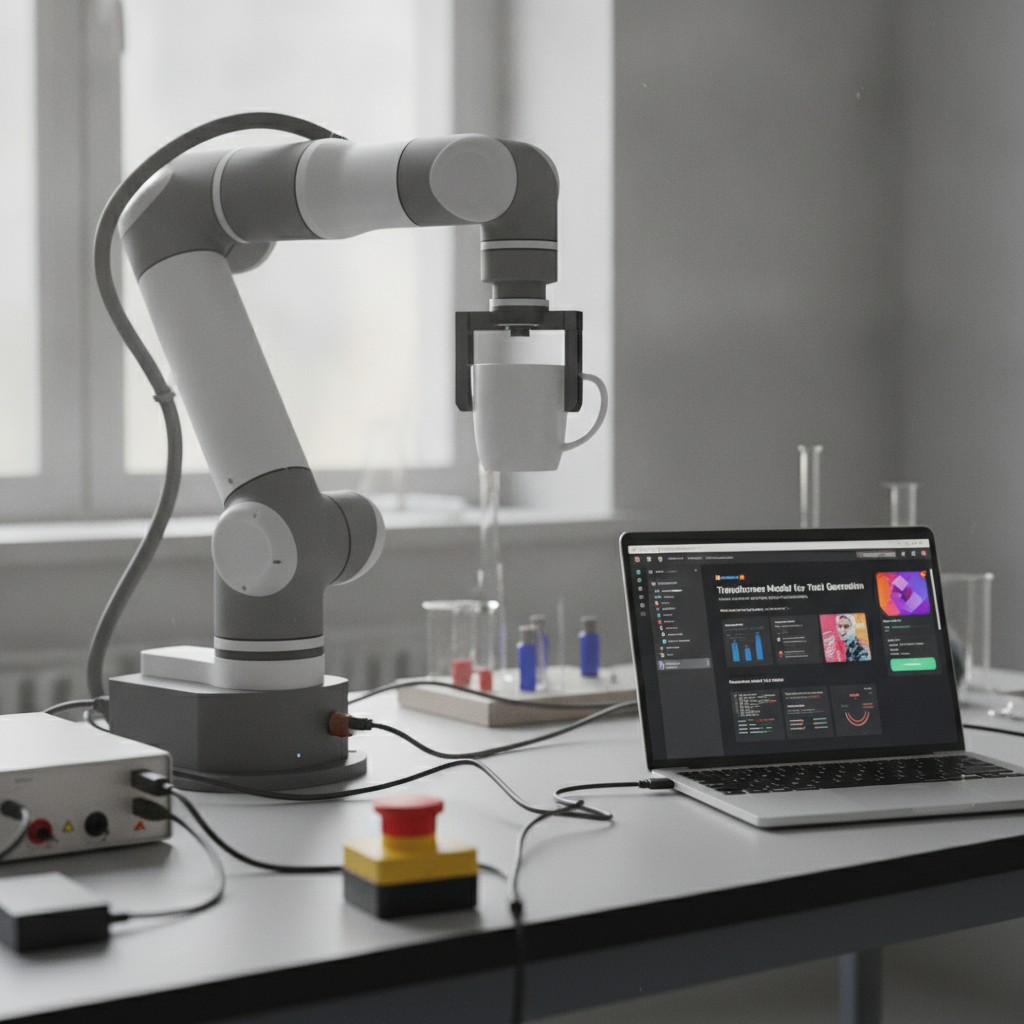
Amazon and Hugging Face just tightened the loop between robot learning research and real-world deployment. Their latest update connects STRANDS, LeRobot, and a new Hub-to-Hardware path so teams can go from datasets to running policies on physical arms—without bespoke pipelines.
Read the announcement and technical details on Hugging Face: Amazon STRANDS + LeRobot + Hub-to-Hardware. Also see the LeRobot library on GitHub: huggingface/lerobot.
What’s new
- STRANDS: Amazon’s contribution that strengthens open robot learning with shared tasks and data, designed for reproducible training and evaluation.
- LeRobot: Hugging Face’s unified library for datasets, policies, and evaluation across common manipulation platforms.
- Hub-to-Hardware: A deployment path that lets you pull a policy from the Hugging Face Hub and run it on supported robot stacks with minimal glue code.
Why it matters
- Standardized model cards and datasets reduce integration guesswork and speed up iteration.
- Hardware abstraction means you can reuse policies across similar arms and grippers with fewer changes.
- Reproducible baselines let you benchmark fairly and know when your tweaks actually help.
Quick start: From Hub to your robot in five steps
- Pick a baseline: Start with a published policy or dataset highlighted in the announcement.
- Check the model card: Confirm supported robots, sensors, and any calibration notes; note safety guidance and expected task success rates.
- Dry run in simulation: Validate perception, control frequency, and coordinate frames before touching hardware (e.g., Gazebo/Isaac Sim).
- Deploy via Hub-to-Hardware: Use the provided connector to stream observations to the policy and send actions to your controller; verify topic/port mappings.
- Measure and roll back: Log success metrics, latency, and failure modes. Keep a safe rollback posture if behavior drifts.
Practical tips
- Match domains: Align training data lighting, backgrounds, and objects with your workspace to narrow sim-to-real gaps.
- Calibrate early: Camera extrinsics and end-effector calibration pay outsized dividends in grasp stability.
- Constrain actions: Apply velocity/force limits and define no-go zones to protect people and equipment.
- Iterate with small deltas: Change one variable at a time—dataset slice, reward tweak, or control rate—and track results.

Risks and reality checks
- Dataset bias: Policies trained on narrow scenes may overfit; expect drop-offs in novel lighting or object sets.
- Latency budgets: Vision + policy + control loops must stay within your robot’s safe cycle time.
- Safety and liability: Always add interlocks, estops, and supervised trials before autonomous runs.
The takeaway
STRANDS + LeRobot + Hub-to-Hardware is a credible end-to-end, open pipeline for robot learning. It shrinks the gap between papers and production rigs—use it to standardize experiments, speed up deployment, and share results the community can reproduce.
Want more bite-sized AI breakdowns like this? Subscribe to our newsletter: theainuggets.com/newsletter.
