



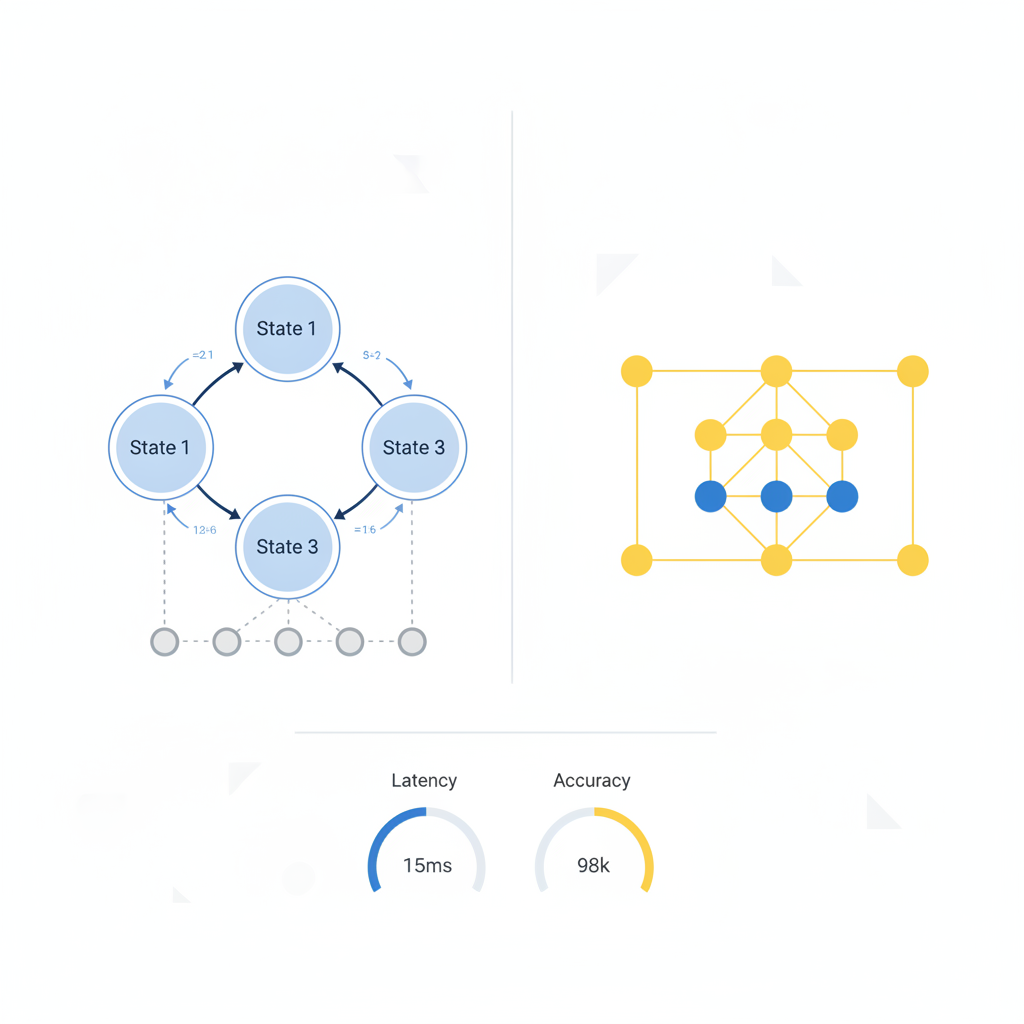
IBM Research’s new post on Hugging Face highlights ALT‑K‑Evolve HMM—a fresh look at how Hidden Markov Models (HMMs) can complement modern neural networks. The practical takeaway: structured, interpretable sequence models are back, especially when you need control, data efficiency, and speed. Source: IBM Research on Hugging Face.
What’s the practical value?
- Interpretability: HMM states and transitions make decisions traceable and auditable—useful for regulated workflows.
- Data efficiency: With fewer parameters and strong inductive bias, HMMs learn useful structure from small or weakly labeled datasets.
- Control & constraints: You can hard‑code allowable transitions to enforce business rules and reduce failure modes.
- Latency & edge‑friendliness: Decoding via Viterbi/forward‑backward is fast and memory‑light compared to large neural nets.
Where HMMs beat pure deep nets
- Low‑data regimes: Bootstrapping reliable sequence models when labeled data is scarce.
- Structured tasks: Enforcing valid tag orders, workflow states, or domain constraints.
- Latency‑sensitive products: On‑device or real‑time inference where milliseconds matter.
How to apply this idea today
- Start simple: Fit a baseline HMM (e.g., hmmlearn) to your sequence features to establish a fast, interpretable baseline.
- Hybridize: Use a neural network to produce emissions or features, with the HMM modeling state transitions. Train with EM for the HMM and SGD for the neural part.
- Constrain behavior: Encode domain rules directly into the transition matrix (e.g., disallow illegal state jumps, add penalties).
- Evaluate like a pro: Track negative log‑likelihood, Viterbi accuracy, sample efficiency (performance vs. data size), and tail‑latency (p95/p99).
- Deploy smartly: Run the HMM at the edge for gating or pre‑filtering; escalate to a heavier model only when needed.
Risks and caveats
- Limited long‑range memory: Vanilla HMMs model Markovian dependencies; long‑context tasks may still need transformers/SSMs.
- Initialization matters: EM can get stuck in local optima; use multiple restarts and good priors.
- Choosing K is non‑trivial: Use validation curves, BIC/AIC, or domain guidance to pick the number of hidden states.
Read more
Original post: ALT‑K‑Evolve HMM by IBM Research. For background, see the classic tutorial by Rabiner (Proceedings of the IEEE, 1989) and modern “Neural HMMs” (arXiv:1805.09866).
Takeaway: HMMs are a powerful control layer for sequence tasks—pair them with neural models when you need structure, speed, and auditability.
Like this Nugget? Get weekly, practical AI insights in your inbox—subscribe to our free newsletter: theainuggets.com/newsletter.
