



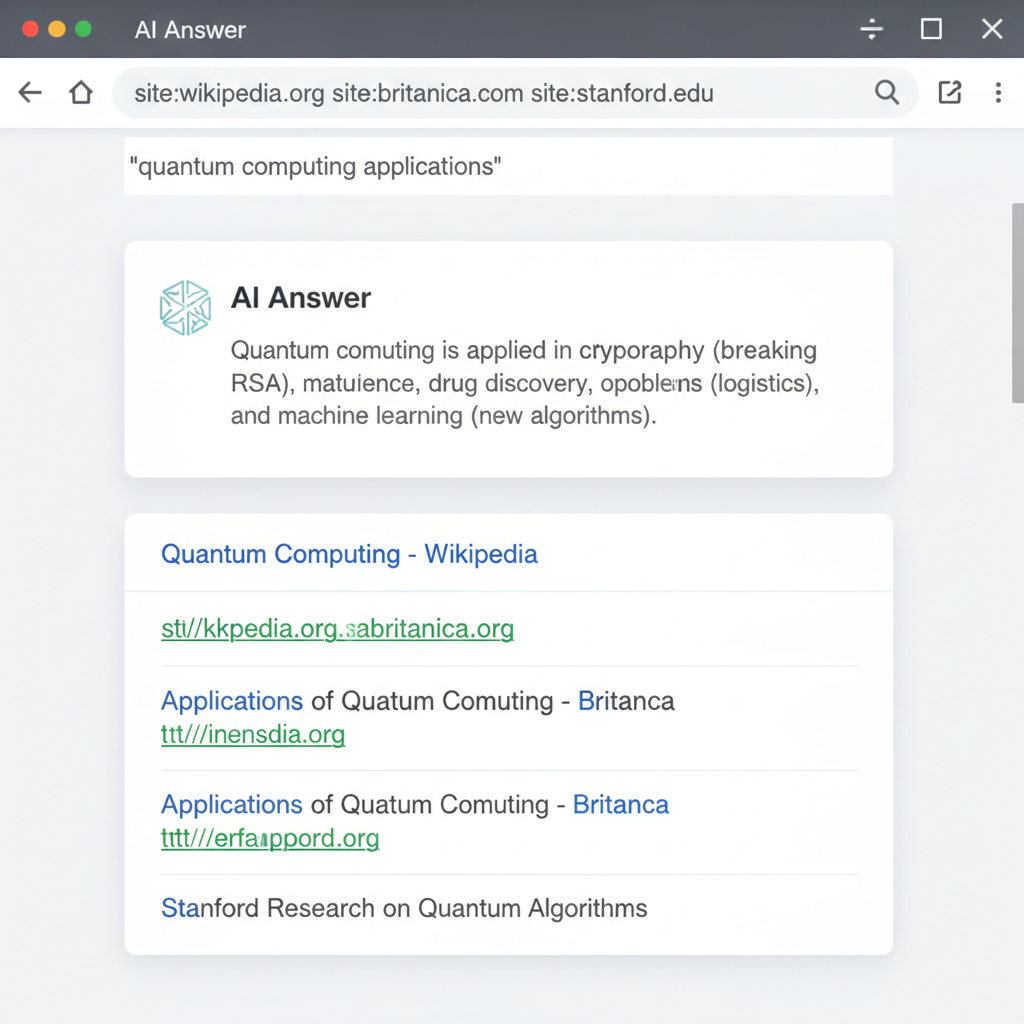
ChatGPT Search appears to be leaning on the classic search operator site: to assemble answers from specific domains, according to observations documented by Simon Willison. If true, this is a big clue to how results are being scoped and which sources get prioritized.
What is the site: operator?
The site: operator limits web results to one or more domains (e.g., site:nih.gov). It’s supported by major engines and is a staple for precise research. See Google’s official guide to search operators here.
Why this matters
- Precision and trust: Steering retrieval toward known-good sources can reduce noise and misinformation.
- SEO implications: If ChatGPT favors clusters of trusted domains, brand visibility may shift toward well-structured, authoritative sites.
- Reproducibility: Users can often approximate the underlying retrieval with conventional search—useful for auditing answers.
- Source control: Publishers can influence inclusion via technical signals (robots, sitemaps, structured data) and content quality.
How to reproduce ChatGPT Search manually
- Scope to multiple domains with OR:
(site:nih.gov OR site:who.int OR site:cdc.gov) “long covid guidelines” - Refine by title focus:
(site:arxiv.org OR site:nature.com) intitle:"diffusion models" benchmarks - Exclude noise:
site:github.com vector database -tutorial -awesome - Add exact phrases or file types:
(site:mit.edu OR site:stanford.edu) "retrieval augmented generation" filetype:pdf - Time-box with before/after (where supported):
(site:openai.com OR site:anthropic.com) "safety" after:2024-01-01
Prompt patterns to steer ChatGPT Search
- “Prefer sources such as [list 3–6 domains] and cite URLs inline.”
- “If sources disagree, show the competing claims with links and dates.”
- “Only use primary documentation from [vendor docs, standards bodies] unless asked otherwise.”
- “Return 3–5 links first, then summarize—don’t answer until links are shown.”
For publishers and SEO teams
- Ensure crawl-friendly setup: clean robots.txt, XML sitemaps, fast pages, and consistent canonical tags.
- Use structured data (schema.org) and clear, scannable headings—models and search both reward clarity.
- Publish original, well-cited content; summaries of summaries are less likely to be prioritized.
- Review AI crawler controls—OpenAI’s GPTBot can be allowed or disallowed at /docs/gptbot. Align with your content policy.
Bottom line
If ChatGPT Search is indeed applying site: at scale, you can reverse-engineer many results with a handful of operators—and you can guide the model toward better sources with explicit prompt constraints. Publishers should double down on technical SEO and authoritative content to stay in the retrieval set.
Want bite-sized AI insights like this in your inbox? Subscribe to The AI Nuggets.
