



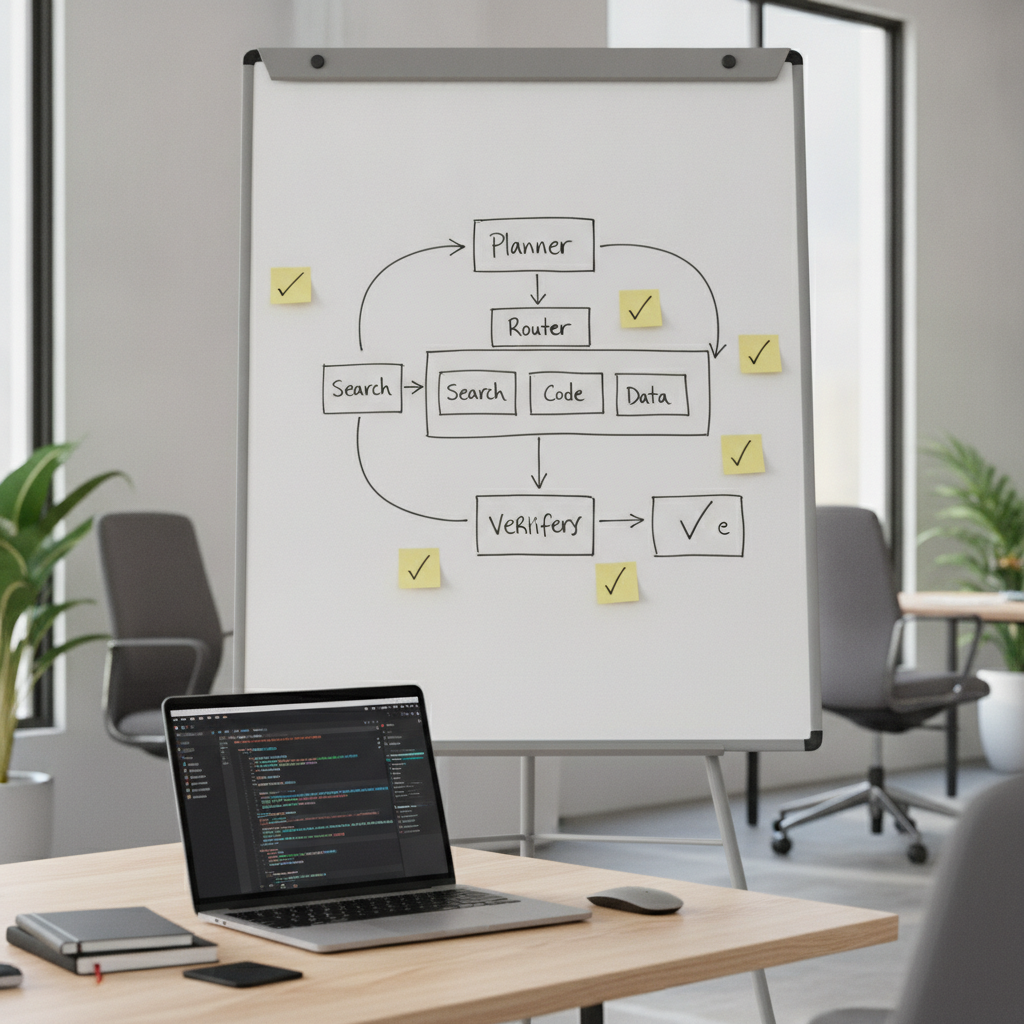
Multi-agent is no longer hype—it’s product reality. As Latent Space frames it in “Zawinski’s Law of Multi‑Agents,” serious LLM apps tend to evolve from single prompts into coordinated teams of agents to plan, specialize, and verify. Source: Latent Space.
What this “law” means for builders
As tasks get complex, a single prompt struggles. Agentic systems break work into steps, assign roles, use tools, and verify outputs—improving quality without hand-holding every token.
When multi‑agent helps
- Complex, multi-step workflows (research → draft → review → finalize)
- Parallelizable sub-tasks to cut latency (specialists working at once)
- Tool-heavy tasks (search, code exec, APIs, spreadsheets)
- Auditable trails and repeatability (explicit steps over opaque chat)
When not to use it
- Simple, single-turn Q&A or extraction
- Tight latency/cost budgets where orchestration overhead dominates
- Strict data controls where tool calls/agent memory complicate compliance
Proven agent patterns you can ship now
- Writer–Critic: a generator drafts; a critic verifies facts/style with citations before final.
- Planner–Executor: a planner decomposes work; executors use tools; a finalizer composes the answer.
- Router–Specialists: a lightweight router sends tasks to domain agents (code, data, legal) with fallbacks.
- Debate/Consensus: 2–3 agents propose answers; a judge picks or merges. Use sparingly—costly.
- Guardrail/Verifier: an independent checker enforces schema, policy, and safety before delivery.
Architecture tips (what actually works)
- Model the workflow as a graph/state machine, not free-form chat. Tools like LangGraph make branching, retries, and memory explicit.
- Prefer function calling/structured I/O (JSON schemas) for deterministic handoffs between agents.
- Ground decisions with tools: retrieval, web search, code execution, DB queries.
- Add observability from day 1 (traces, tokens, latency, step outcomes). LangSmith or W&B Traces help.
- Budget control: per-step token limits, early-exit heuristics, and circuit breakers on loops.
- Evaluate with task-level success, not vibes. Use pairwise LLM judges plus spot human review.
- Cache aggressively (RAG chunks, tool results, final answers) to cut cost/latency.
Risks and how to mitigate
- Role drift: agents forget their contract. Mitigate with strict schemas, short memories, and role reminders.
- Runaway loops: planners keep re-planning. Add max-steps and watchdog agents.
- Tool hallucination: fake API responses. Verify with typed tool outputs and checksum logic.
- Quality collapse under pressure: fall back to a strong single-agent baseline when confidence is low.
- Cost creep: track per-run spend; prune agents that don’t change outcomes.
Benchmarks & evidence to watch
Agent evaluations are still evolving. For deeper background, see AgentBench (evaluating LLMs as agents): arXiv. Also follow vendor evals and open traces from real apps.
Quick-start stack
- Graph orchestration: LangGraph
- Retrieval: your vector DB of choice + concise, typed tool outputs
- Judging: lightweight verifier agent with strict JSON schema
- Observability: LangSmith or W&B Traces; export OpenTelemetry
Takeaway
Start small: 2–3 agents with clear contracts, structured handoffs, and hard budgets. Add complexity only if your metrics prove quality or latency improves.
If you found this useful, subscribe to our free newsletter for weekly, practical AI nuggets: theainuggets.com/newsletter.
Further reading: Latent Space’s overview of the trend—“Zawinski’s Law of Multi‑Agents.” Read it here.
