



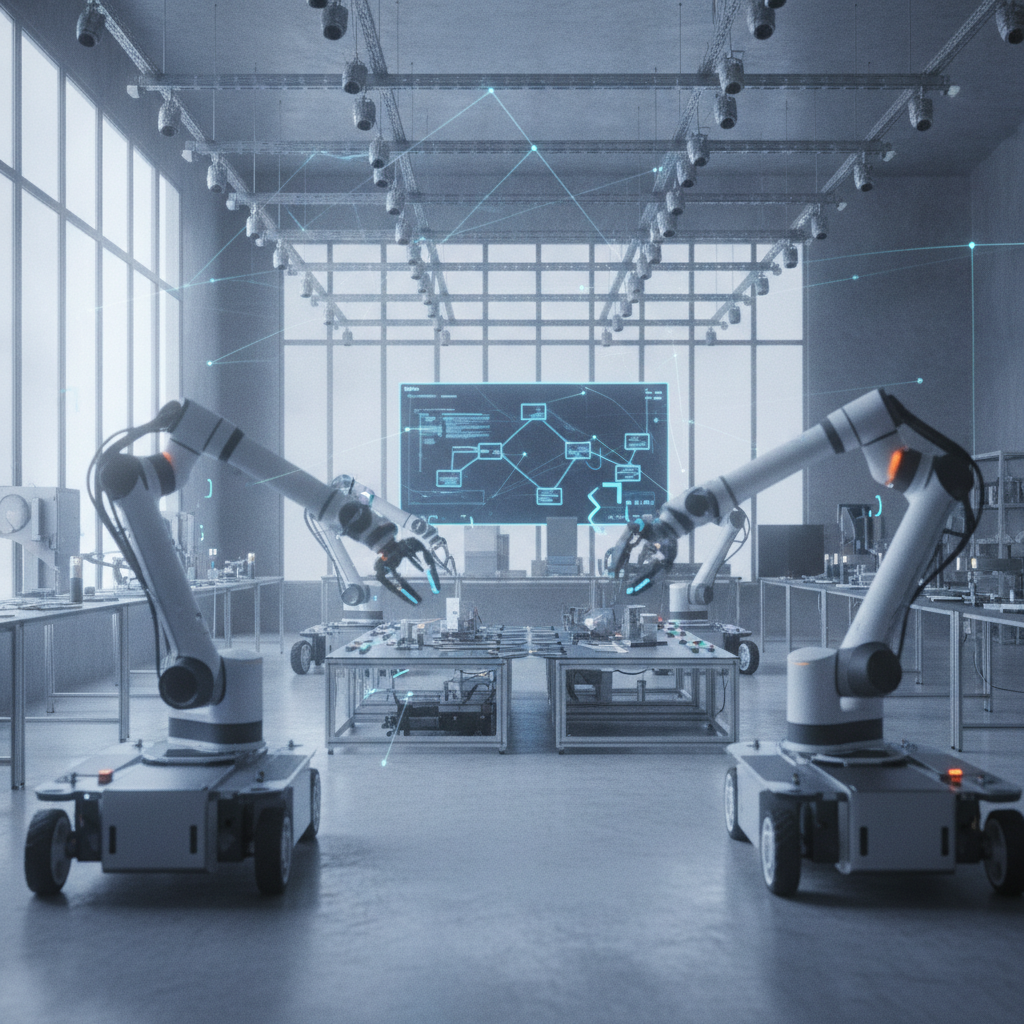
Google DeepMind’s latest update to Gemini Robotics (ER 2) pushes robots closer to real work. The headline: video understanding and task orchestration that coordinate multiple robots with less hand-tuning.
DeepMind details these capabilities and demos in its announcement: Gemini Robotics ER 2.
What’s new in ER 2
- Video understanding: The model parses long, natural video to ground instructions in the scene (objects, affordances, constraints) without brittle, hand-crafted rules.
- Task orchestration: It decomposes goals into ordered sub‑tasks, invokes tools or skills as needed, and adapts when the environment changes.
- Multi‑robot collaboration: A shared planner assigns complementary roles so teams can parallelize work, reduce idle time, and recover from single‑robot failures.
Why it matters for operations
- Lower integration cost: Natural language + video grounding can replace many custom scripts and per‑fixture calibrations.
- Higher throughput: Task graphs reduce waiting and let robots work in parallel on long‑horizon jobs.
- Fewer surprises: Global video context helps the system re‑plan when tools move, shelves shift, or people enter the scene.
30‑day pilot blueprint
- Week 1 – Scope a single, high‑variance workflow (e.g., restocking, order kitting, office cleanup). Define success metrics: task success rate, time per task, handovers, safety events.
- Week 2 – Capture 4–6 hours of representative video from fixed and mobile cameras. Label only what’s essential: key objects, start/end states, blocked paths.
- Week 3 – Build a small skill library (pick/place, open/close, scan, wipe). Expose each as a callable tool with clear pre/post conditions.
- Week 4 – Enable multi‑robot handoffs (who picks vs. who transports). Test re‑planning by moving items mid‑task. Log every step for traceability.
Data and infrastructure checklist
- Cameras: Overhead + eye‑in‑hand for depth/occlusion. Ensure time sync and stable lighting.
- State: Lightweight inventory or map service so the planner can query “what’s where.”
- Skills: Keep skills atomic and testable; version them like APIs.
- Safety: Define keep‑out zones, speed limits near humans, and auto‑stop on low confidence.
- Observability: Central log of prompts, sub‑tasks, tool calls, errors, and video snippets.
Risks and guardrails
- Hallucinated steps: Require explicit pre‑/post‑condition checks before executing each sub‑task.
- Ambiguous instructions: Force disambiguation prompts when the scene lacks a unique referent.
- Domain drift: Re‑validate after layout changes; keep a weekly “golden set” replay.
- Multi‑robot deadlocks: Add timeouts, back‑off strategies, and a tie‑breaker for shared resources.
Use cases to try first
- Warehouses: Parallel pick‑transport‑pack flows with dynamic shelf locations.
- Offices: Nightly resets—clear desks, sort items, wipe surfaces, return assets.
- Hospitals: Supply runs where one robot fetches and another delivers across floors.
Bottom line
ER 2’s combo of video grounding and orchestration is a step toward robots that learn and coordinate from context, not just code. Start small, measure tightly, and iterate weekly.
Subscribe for more practical AI breakdowns: theainuggets.com/newsletter
