



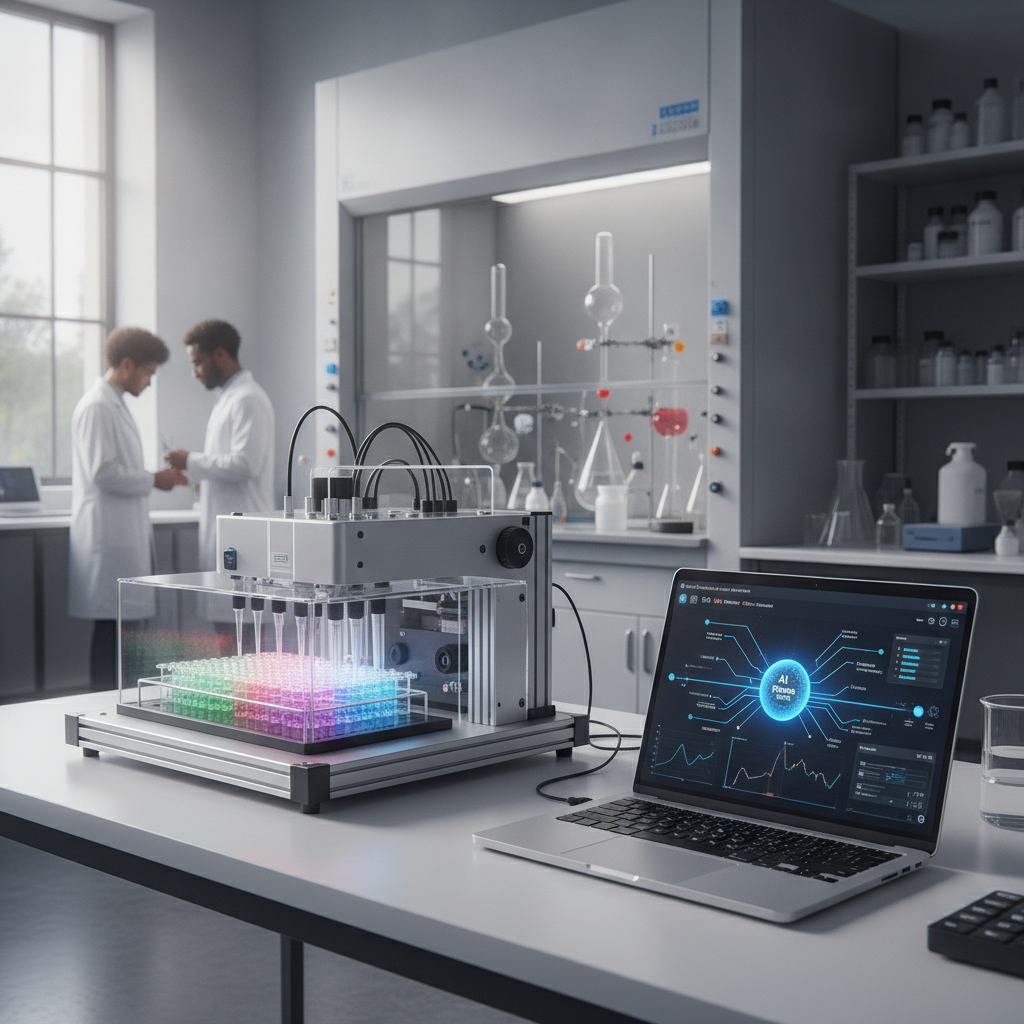
OpenAI has outlined an “AI Chemist” approach designed to improve chemical reaction workflows—from planning to optimization and execution. Read the announcement: OpenAI: AI Chemist improves reaction.
Why this matters
- Faster cycles: Automates plan–run–learn loops to reach viable conditions sooner.
- Lower costs: Fewer failed trials and better use of reagents, plates, and instrument time.
- Higher yields and robustness: Systematically explores parameters beyond human intuition.
- Safer labs: Automates hazardous or repetitive steps and enforces constraints.
How an “AI Chemist” typically works
- Planning: A language-model agent drafts candidate routes, reagents, and conditions, grounded in literature and prior data.
- Prediction: Models estimate yield/selectivity under different conditions to prune the search space.
- Optimization: Bayesian optimization or design-of-experiments proposes the next batch.
- Execution: Robotic platforms or guided bench protocols run reactions; results stream back to the agent.
- Feedback: The system updates priors and repeats until targets (yield, purity, cost, time) are met.
Quick-start playbook for labs
- Data first: Standardize historical reactions (substrates, solvents, temperatures, outcomes). Consider the Open Reaction Database (ORD) schema for structure.
- Cheminformatics stack: Use RDKit for descriptors, reaction templates, and basic enumeration.
- Modeling: Start with simple surrogates (random forest, Gaussian processes) before deep models. Emphasize uncertainty estimates.
- Optimization loop: Apply Bayesian optimization or DOE. Constrain proposals by safety, availability, and regulatory limits.
- Human-in-the-loop: Let chemists approve batches and set guardrails. Log rationales for traceability.
- Integration: If you lack robots, run 96-well plates manually with barcodes and upload results to the agent.
Metrics to track
- Time-to-target yield or purity
- Number of experiments per successful condition
- Reagent and consumables cost per hit
- Reproducibility across operators/instruments
- Scale-up fidelity from micro- to gram-scale
Risks and guardrails
- Data bias: Historic ELN data may overrepresent “easy” chemistries; validate on held-out classes.
- Extrapolation risk: Models can overfit; require uncertainty thresholds before proposing out-of-domain conditions.
- Safety: Enforce reagent compatibilities, pressure/temperature caps, and quench rules programmatically.
- Compliance: Maintain full audit trails to support GLP/GMP environments.
- Human oversight: Keep chemists in approval loops for novel transformations.
Takeaway
Agentic AI for chemistry is moving from demo to practice. Start small: clean your reaction data, pilot a closed-loop optimizer on one transformation, and measure time-to-yield. The labs that operationalize this loop first will bank compounding speed and cost advantages.
Enjoyed this nugget? Subscribe for weekly, no-fluff insights: The AI Nuggets Newsletter.
