



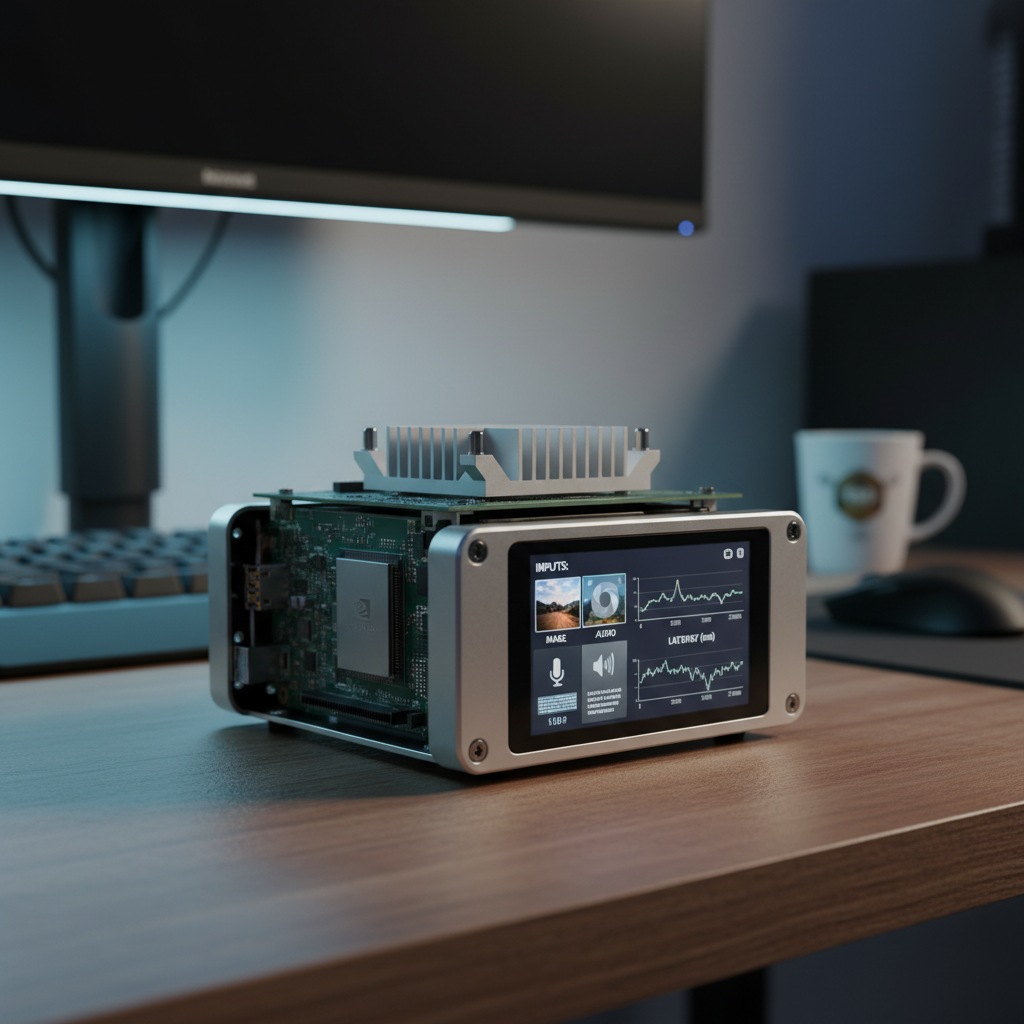
Small, fast, multimodal models are here. NVIDIA’s Nemotron-3 Nano—featured on Hugging Face—shows how compact models can handle text-plus-vision tasks with low latency and tight resource budgets. This guide gives you a pragmatic playbook to evaluate and ship them.
Source: Hugging Face x NVIDIA: Nemotron-3 Nano
Why this matters
- Latency and privacy: On-device or near-edge inference keeps data local and responses snappy.
- Cost control: Smaller checkpoints mean lower GPU/CPU memory and more predictable spend.
- Simpler stacks: One model handling text and vision trims orchestration complexity.
Quick-start playbook
- Clarify the job: captioning images, visual Q&A, document understanding, or multimodal RAG.
- Check the model card and license before you prototype.
- Try the live demo or Space linked from the blog post.
- Measure a baseline: p50/p95 latency, throughput (items/sec), and memory (VRAM/RAM) at your target batch size and image resolution.
- Tune inputs: compress images, resize to native model expectations, standardize formats (e.g., RGB, 224–448 px).
- Optimize inference: experiment with quantization (e.g., 8-bit/4-bit), operator fusion, and hardware-accelerated runtimes.
- Evaluate quality: build a 50–200-example test set with representative lighting, fonts, and noise; score accuracy and failure modes.
- Guardrails: enforce image size/type limits, runtime timeouts, and prompt templates to reduce degeneracy.
- Ship a thin API: expose a single /infer endpoint with schema-validated JSON for text+image inputs.
- Observe: log latency, GPU memory, and error rates; sample outputs for drift and prompt regressions.
Benchmarks that actually matter
- Task success rate on your own examples beats leaderboard scores.
- Cold-start p95 latency often dominates UX; measure first-token and full-response times.
- Throughput per dollar: items/sec/GPU-hour or items/sec/watt for edge devices.
- Robustness: test glare, low light, motion blur, and document skew for vision-heavy tasks.
Deployment patterns
- Edge device: run locally for privacy-critical capture (retail, field ops). Sync only metadata or derived text.
- Near-edge GPU: colocate with data source to cut egress and latency; batch across streams.
- Hybrid: quick on-device triage, escalate hard cases to a larger cloud model.
Quality and safety checklist
- Dataset fit: validate on your lighting, language, and document types.
- Prompt recipes: standardize system prompts; keep temperature deterministic for production.
- Red teaming: test for hallucinated text, misread numerics, and sensitive content leakage.
- Human-in-the-loop: route low-confidence outputs to review with clear UI cues.
Where small multimodal models shine
- Visual helpdesk: clarify screenshots and UI states with short, actionable text.
- Field service: read gauges, serial numbers, and labels in harsh conditions.
- Doc AI: extract entities from invoices, receipts, and forms with embedded images.
- Retail: shelf checks and planogram variance highlighting on-device.
Key takeaway
Start tiny, measure what matters, and iterate. Nemotron-3 Nano highlights a bigger trend: compact multimodal models are production-ready when paired with disciplined evaluation and edge-aware deployment.
Stay ahead with practical AI playbooks—subscribe to our newsletter: theainuggets.com/newsletter
