



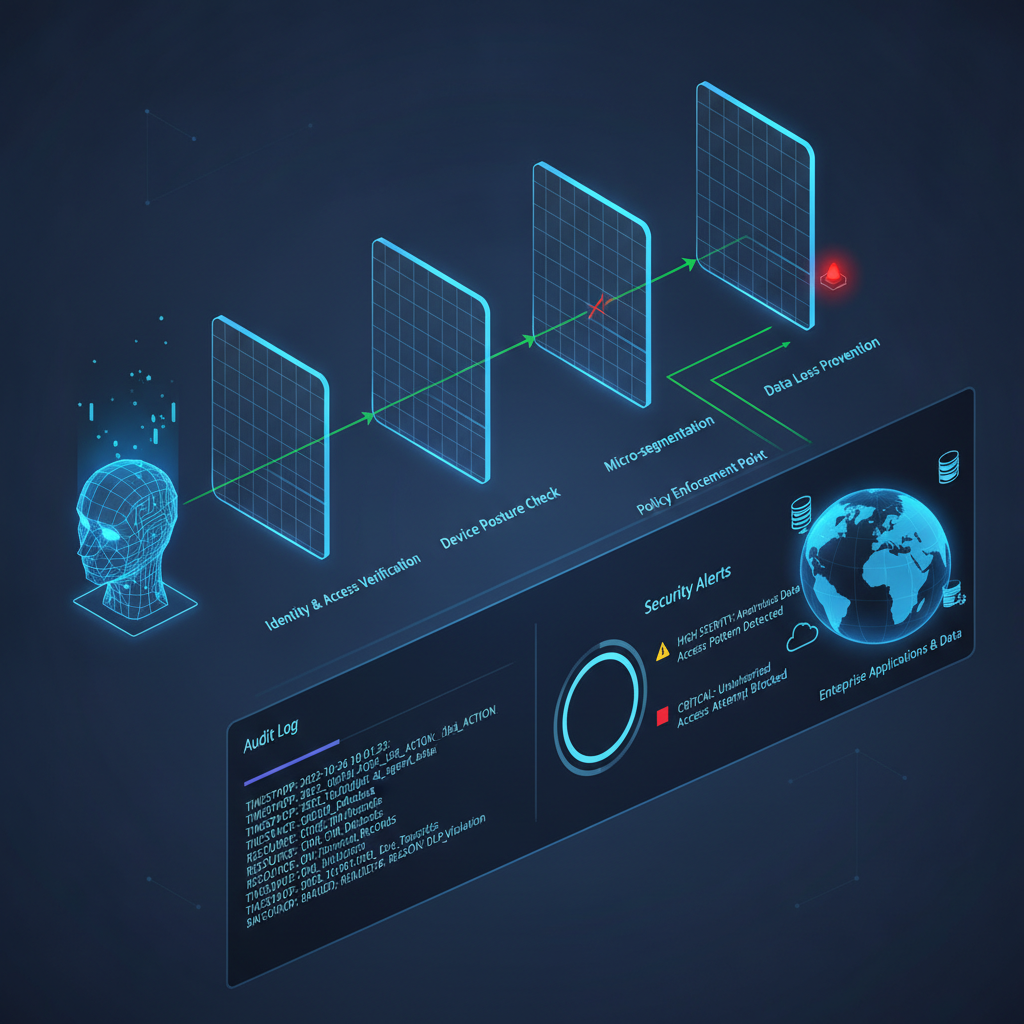
AI agents are moving from demos to production. That means they need access to real data and tools—safely. Cloudflare’s Agent Access Model offers a practical, Zero Trust way to grant and govern that access without ballooning risk.
What is the Agent Access Model?
Cloudflare’s Agent Access Model treats AI agents as first-class identities subject to enterprise access controls. Instead of giving broad, static credentials, it enforces least privilege, just-in-time access, and policy checks on every tool call—backed by strong observability and audit trails.
Why it matters now
- Tool use expands blast radius: agents can read files, call APIs, or trigger workflows—one bad prompt can escalate quickly.
- Secrets and data leaks: hard-coded keys or overbroad tokens leak easily in prompts, logs, or retries.
- Compliance and audit: you need who-did-what-when for agents, not just human users.
- Supply chain risk: model providers, plugins, and third-party APIs add new trust boundaries.
Core principles to adopt
- Treat agents as identities: issue unique identities for agents and sub-agents; manage lifecycle like users and services.
- Default deny and least privilege: grant the minimum scope to the minimum resource for the minimum time.
- Just-in-time, short-lived credentials: mint scoped tokens per action or session; rotate automatically.
- Policy checks per tool call: enforce data classification, DLP, and domain allow-lists on every retrieval or API call.
- Human-in-the-loop for high risk: require step-up approval for payments, deletions, or permission changes.
- Full observability: log prompts, tool invocations, inputs/outputs, and decisions; keep tamper-evident audit trails.
- Secure compute and egress controls: sandbox runtime, isolate tenants, and restrict outbound destinations.
- Data minimization: redact PII, use retrieval guardrails, and constrain context windows to what’s necessary.
A practical rollout (Cloudflare example)
- Identity and scopes: define an agent identity with fine-grained roles. Use short-lived, scoped tokens for each tool invocation.
- Zero Trust broker: put a policy engine in front of data sources and SaaS apps (e.g., URL/category allow-lists, DLP, geo/time rules).
- Per-call enforcement: evaluate each retrieval/API call against policy (classification, data owner, purpose) before releasing credentials.
- Secrets management: store keys centrally; never embed secrets in prompts. Inject at runtime with least privilege.
- Observability: route model traffic through an AI gateway for logging, rate limits, cost controls, and provider failover.
- Risk gating: require approval or multi-party controls for destructive or financial actions; record the human decision in the audit log.
- Containment: run agents in sandboxed environments with egress filtering; segment data stores and sanitize RAG context.
Quick checklist
- Agent has a unique identity and role
- Default-deny policies across tools and data
- Short-lived, scoped, per-action credentials
- DLP and allow-lists enforced on every call
- Human approval on high-impact operations
- Comprehensive, tamper-evident logging
- Sandboxed runtime and controlled egress
- Context minimization and PII redaction
Sources
• Cloudflare: The Agent Access Model
• OWASP: Top 10 for LLM Applications
Takeaway
Treat AI agents like powerful service accounts behind Zero Trust controls. With least privilege, per-call policies, short-lived credentials, and full auditability, you can unlock real workflows without inviting real breaches.
Enjoy this nugget? Subscribe for weekly, no-fluff insights: theainuggets.com/newsletter
