



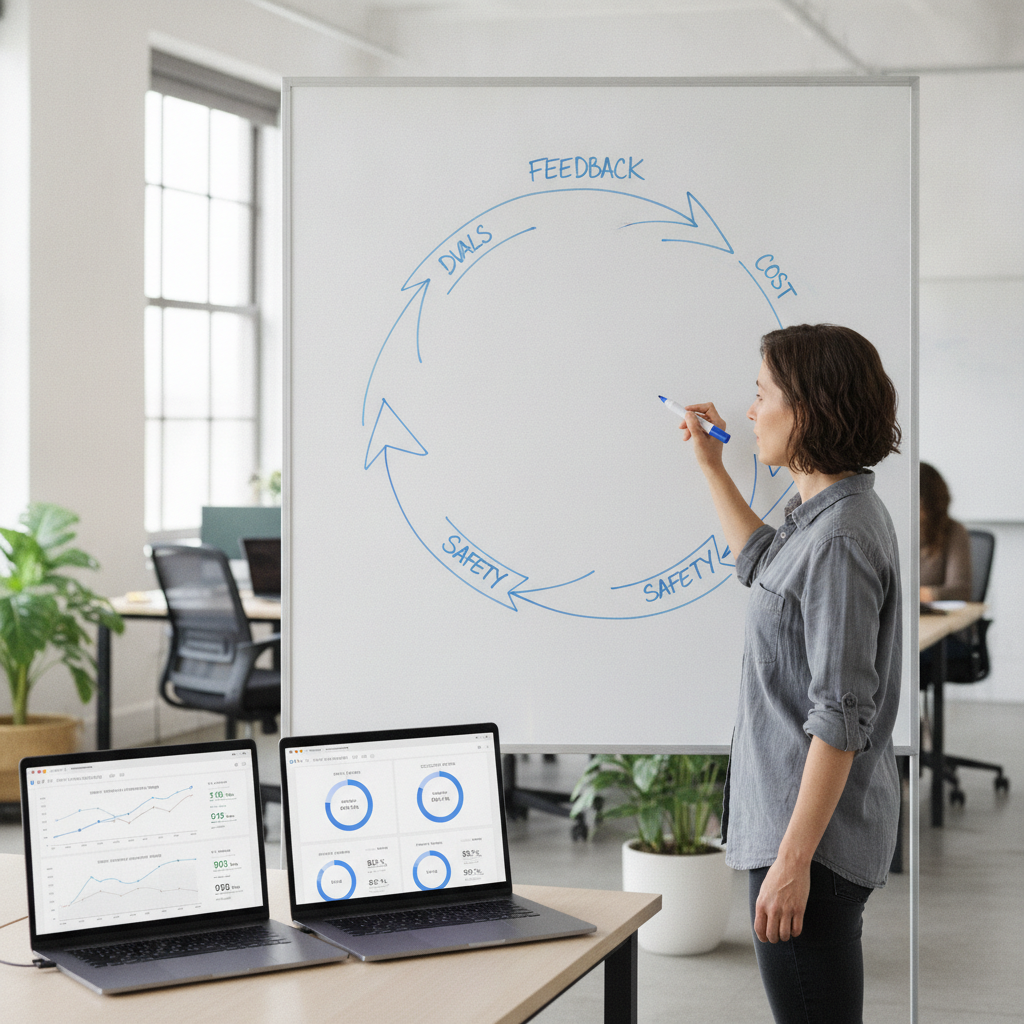
Stop shipping one-shot prompts. Build closed loops so your LLM features get measurably better every week.
This piece distills key ideas from Latent Space’s AIEWF Daily Dispatch on “Loops” and turns them into a practical checklist you can ship now. Source: Latent Space.
What “loops” mean in AI engineering
Loops are the engine of continuous improvement for AI products. Instrument, observe, evaluate, and refine—on repeat.
Unlike one-off prompt tweaks, loops let you measure real user outcomes, fix regressions fast, and compound quality over time.
The 5 essential loops for LLM products
- Feedback loop: Capture explicit ratings and implicit signals (edits, abandon, retries). Log structured traces with IDs so you can replay and compare.
- Evaluation loop: Maintain a living eval set. Run offline evals on every change and gate releases on quality deltas.
- Data curation loop: Funnel failures and edge cases into labeled datasets. Generate targeted synthetic examples to cover gaps.
- Cost/latency loop: Track token spend, cache hit rate, latency percentiles, and timeout fallout. Enforce budgets and fallbacks.
- Safety/guardrail loop: Run policy checks and red-team prompts pre- and post-release. Audit blocked vs. allowed rates and false positives.
Ship it in a week: a minimal loop architecture
- Day 1 – Tracing: Add request_id to every call. Log inputs, system prompt, model/version, outputs, latency, tokens, and user outcome.
- Day 2 – Success criteria: Define “task success.” Build a 50–100 item eval set from real tasks and high-signal failures.
- Day 3 – Feedback UI: Add thumbs up/down with optional short reason. Record post-edit distance and time-to-completion.
- Day 4 – Offline eval job: Nightly run on latest prompt/graph. Compare against baseline and flag regressions automatically.
- Day 5 – Performance SLOs: Dashboards for p50/p95 latency, cost per task, error rate, and cache hits. Alert on budget breaches.
- Day 6 – Safety & guardrails: Add input/output filtering and jailbreak checks. Log blocks and appeals for policy tuning.
- Day 7 – Close the loop: Review top failures, add to dataset, re-run evals, and ship behind a feature flag if quality improves.
Metrics that matter
- Task success rate (offline eval and production)
- Edit rate and edit distance after AI output
- Time-to-first-token and total latency (p50/p95)
- Cost per successful resolution
- Safety block rate and false-positive rate
- Regression delta vs. last stable baseline
Common failure modes and quick fixes
- Silent regressions: Gate merges on evals; snapshot prompts and models; compare traces side-by-side.
- Overfitting to evals: Rotate in fresh real-world cases weekly; keep a “holdout” set untouched.
- Prompt drift: Version prompts and templates; pin models for critical paths and test upgrades separately.
- Runaway costs: Add caching, streaming, and early-exit heuristics; enforce per-request and per-user budgets.
- Data leakage: Separate train/eval/production datasets; scrub PII and secrets before logging.
Tools and references
- Latent Space – AIEWF Daily Dispatch: Loops: read the post.
- OpenAI Evals (framework and examples): github.com/openai/evals.
- Langfuse (LLM tracing/observability): langfuse.com.
Takeaway
The fastest AI teams ship loops, not just prompts. Put feedback, evals, data curation, cost control, and safety on rails—and quality will compound.
Get weekly bite-sized playbooks like this. Subscribe to our newsletter: theainuggets.com/newsletter.
