



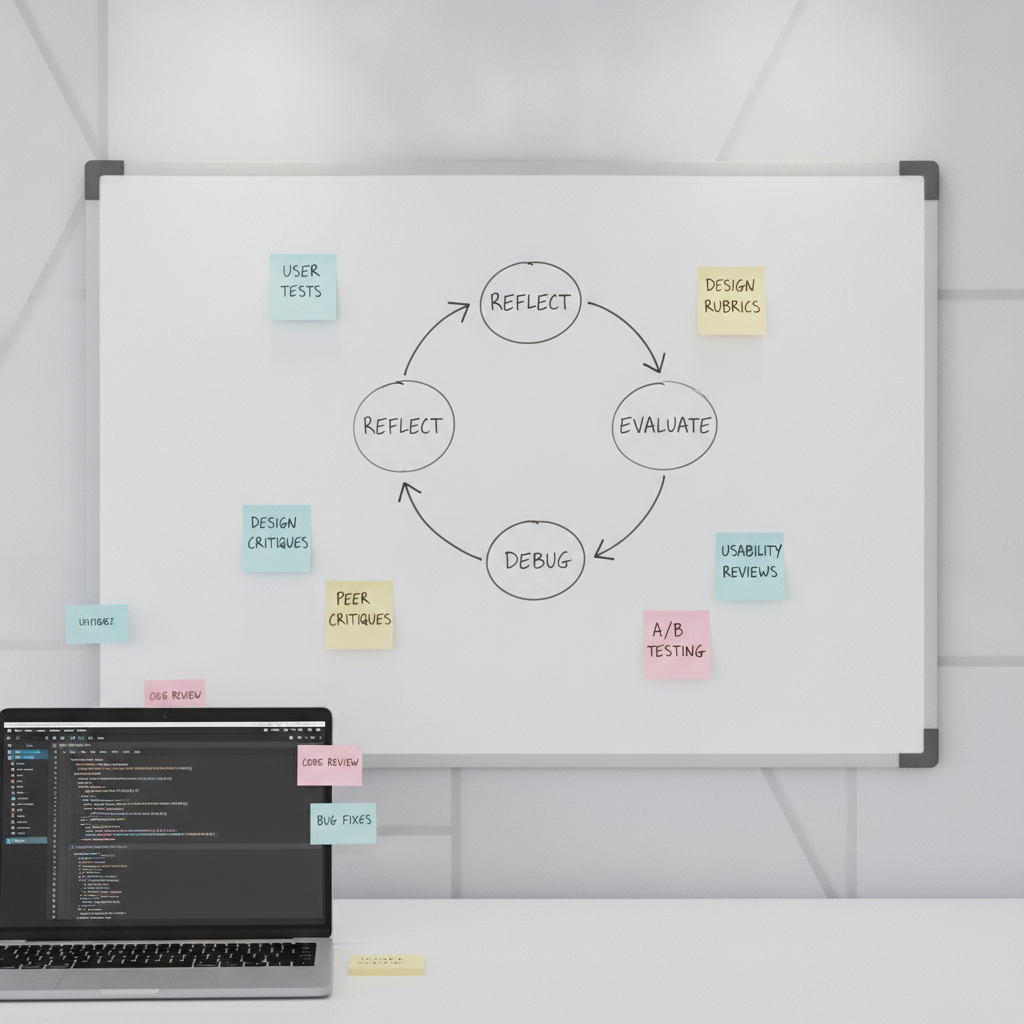
OpenAI just outlined a self-improvement method called RED that helps GPT-style models learn from their own mistakes with minimal human labels. Here’s what it means for builders—and how to try a lightweight version today. Source: OpenAI.
What RED means in plain English
RED is an iterative loop where a model tackles tasks, critiques itself with checks, and produces better answers and data to learn from. The goal: steady gains without costly, large-scale human labeling.
- Reflect: Identify where and why an answer failed or could be stronger.
- Evaluate: Score with automatic tests, rubrics, or preference signals.
- Debug: Generate improved solutions and training examples, then repeat.
Why it matters for teams
- Lower labeling costs by leaning on automated checks and model critiques.
- Faster iteration as you continuously harvest hard examples from your own workloads.
- Better domain fit by training on errors that actually show up in your product.
How to implement a lightweight RED loop today
- Define success signals: unit tests for code, exact/regex match for data tasks, function-call validation, or rubric-based graders for writing.
- Log hard cases from production (fails, low-confidence, user edits) into a “retry” queue.
- Generate multiple candidates per prompt; keep rationales to aid reflection.
- Auto-critique: have a grader (rule-based or model-based) score each candidate and explain weaknesses.
- Self-repair: prompt the model to produce an improved answer using the critique.
- Create training tuples (prompt, critique, improved answer). Fine-tune via supervised learning or preference optimization.
- Track progress on a held-out eval set and rotate in fresh real-world tasks weekly.
Tip: even without fine-tuning, you can prompt-inject the loop—ask the model to reflect (what likely failed), evaluate (score vs. a rubric), and debug (produce a corrected response) before returning a final answer.
Risks and guardrails
- Reward hacking: models may overfit to your graders. Mitigate by using diverse checks, spot human reviews, and periodic blind evals.
- Data drift and collapse: cap the share of synthetic data and mix in fresh human-labeled anchors.
- Leakage: deduplicate and filter near-duplicates between training and eval splits.
- Safety: pair self-improvement with clear policies and red-teaming. See related work like Constitutional AI.
For background on reflective agents and self-critique patterns, see Reflexion (Shinn et al.), which shows how iterative self-feedback can boost reliability.
Takeaway
RED turns everyday mistakes into fuel. Instrument your tasks, grade automatically, and loop improvements—then verify with strong, independent evals.
Like this nugget? Get one fresh, fast, and useful AI update in your inbox—subscribe to our free newsletter: theainuggets.com/newsletter.
