



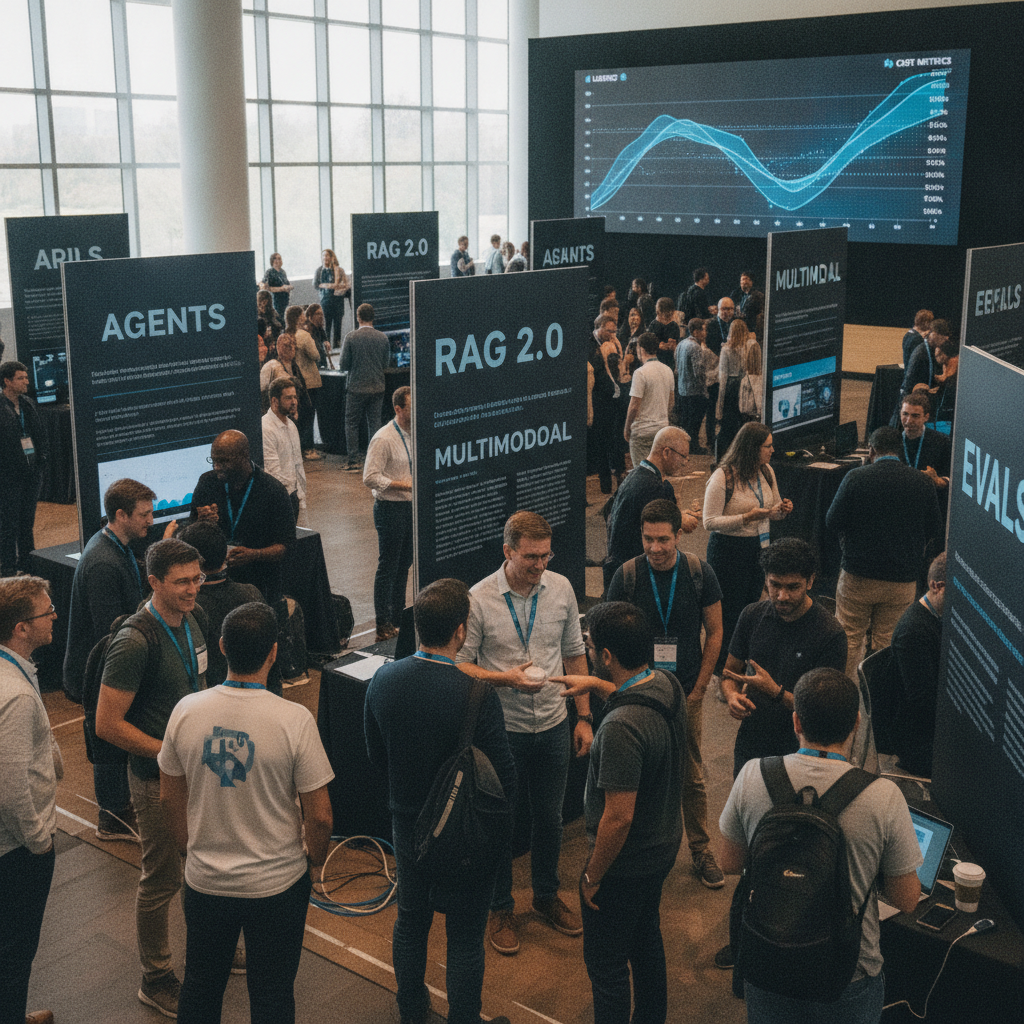
The AI Engineer World’s Fair spotlighted where practical AI is headed. Here are 26 concrete trends—and what to do this quarter to turn them into results. Source: Latent Space: 26 Trends from AIEWF.
Why this matters
- Focus your roadmap on what’s delivering value now, not just hype.
- Cut cost/latency by choosing the right model + architecture per task.
- Ship safer, more reliable AI with evals, observability, and governance built-in.
26 AI engineering trends to watch (and act on)
- Agentic workflows move to production — Do now: start with narrow, tool-using agents and deterministic fallbacks.
- RAG 2.0 becomes system design — Do now: add re-ranking, query rewriting, and measure retrieval quality.
- Evals are non‑negotiable — Do now: build a golden-set harness and run in CI/CD.
- Structured outputs by default — Do now: enforce JSON schemas via function calling or constrained decoding.
- Multimodal is table stakes — Do now: add the one extra modality that reduces user friction most (vision, audio, or video).
- Realtime, streaming UX — Do now: stream tokens and partial UI; design for sub‑second perceived latency.
- Small, specialized models win — Do now: fine‑tune 1–8B models for narrow tasks to slash cost/latency.
- On‑device inference rises — Do now: prototype with WebGPU or mobile accelerators for privacy and offline.
- Synthetic data accelerates quality — Do now: generate → filter → human‑review; track provenance.
- Tool use is the backbone — Do now: define 5–10 robust tools with idempotent APIs and clear contracts.
- Memory and personalization — Do now: begin with session memory; graduate to consented profile stores.
- Safety and governance shift left — Do now: PII redaction, content filters, and audit logs from day one.
- Latency and cost SLOs — Do now: budget per interaction; monitor tokens, GPU minutes, and cache hit‑rates.
- Context caching/KV reuse — Do now: cache prompts/embeddings; reuse attention where supported.
- Hybrid search over just vectors — Do now: combine keyword + vector + re‑rank for relevance and control.
- Flows as graphs/DAGs — Do now: model orchestration explicitly; add tracing and replay.
- Serverless GPUs and spot — Do now: autoscale batch and bursty workloads with fallbacks.
- Open models in prod — Do now: keep a model registry; A/B against closed models for ROI.
- Prompting → program synthesis — Do now: template, unit‑test, and version prompts like code.
- Eval‑driven model routing — Do now: route by price/latency/quality using live eval signals.
- Fine‑tune vs RAG vs agents — Do now: choose per task; measure total cost of ownership.
- Enterprise data readiness — Do now: clean, label, secure, and permission your sources.
- Voice‑first assistants — Do now: architect duplex audio with sub‑300ms turn‑taking.
- Long‑context is selective — Do now: retrieve/summarize first; pay for length only when it moves outcomes.
- LLM observability matures — Do now: capture inputs/outputs, traces, and user feedback loops.
- Compliance‑ready AI — Do now: map controls to SOC 2, GDPR, and model risk policies.
Key resources
- Latent Space recap: AI Engineer World’s Fair — 26 Trends
- Stanford AI Index (ongoing benchmarks and trends): aiindex.stanford.edu/report
- NIST AI Risk Management Framework: nist.gov/itl/ai-risk-management-framework
Takeaway
Pick 3 trends that map to your user journey—then ship a measured improvement in 90 days with evals, observability, and clear cost/latency budgets.
Like this? Get one practical AI nugget in your inbox each week. Subscribe to The AI Nuggets »
