



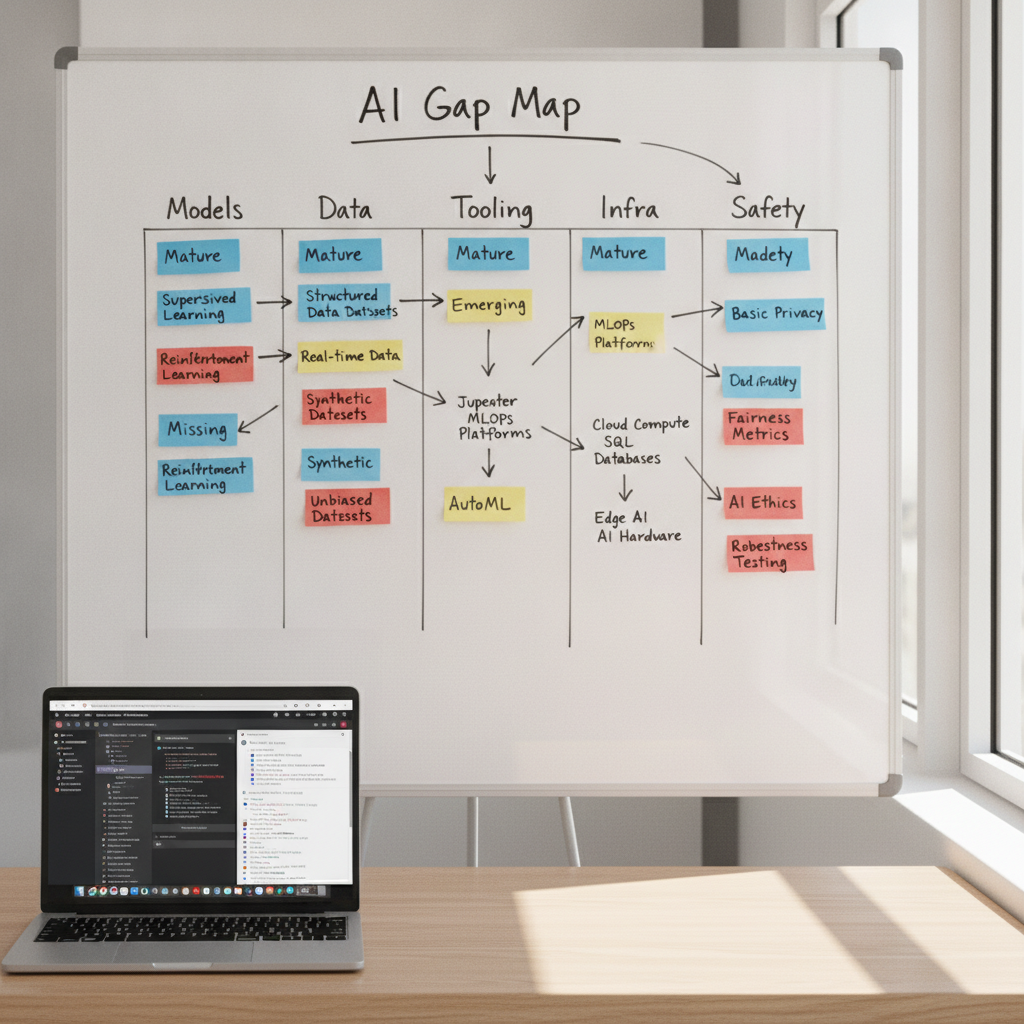
Looking for the most useful place to build or contribute in open‑source AI? Try a Gap Map—a fast way to visualize what’s mature, what’s missing, and where you can create outsized impact.
What is the Open Source AI Gap Map?
It’s a lightweight map of the AI stack—models, data, tooling, infra, and safety—labeled by maturity and need. The aim: reveal high‑leverage opportunities that are blocked by missing components or weak links.
Simon Willison outlines this idea to help the community target work that unlocks progress across projects, not just in one repo.
Build your own Gap Map (60‑minute sprint)
- Define scope: pick a domain (e.g., retrieval, fine‑tuning, evals, agents, inference ops, governance).
- Inventory the stack: list key components and adjacent dependencies (datasets, models, runtimes, SDKs, UIs).
- Tag maturity: 0=missing, 1=prototype, 2=usable, 3=robust. Be honest and cite evidence (issues, benchmarks, docs).
- Score leverage: impact (1–3) vs. effort (1–3). Look for high‑impact/medium‑effort areas.
- Note blockers: licenses, data quality, perf limits, hardware costs, or unclear specs.
- Validate: ask 3–5 users or maintainers where they feel the most pain; update tags and scores.
- Pick bets: shortlist 2–3 gaps you can move in 4–8 weeks via a PR, RFC, or small tool.
How to use the map
- Contribution strategy: focus on gaps that unblock many downstream users, not just one project.
- Roadmapping: turn top gaps into time‑boxed experiments with clear success criteria.
- Founder lens: validate if a gap looks more like a library, a service, or a product wedge.
- Hiring and grants: justify funding by pointing to measured leverage, not hype.
Signals of a high‑leverage gap
- Repeated “glue code” across repos and blog posts.
- Active user demand (issues, discussions) but slow maintainer response.
- Stable enough interfaces to standardize without blocking on novel research.
- Clear upstream/downstream unlocks (e.g., better evals improving fine‑tuning choices).
- Tractable scope for a small team or a month‑long sprint.
Risks and realities
- Maintenance tax: popular gaps become long‑term obligations—plan for upkeep.
- Upstream churn: model and API changes can invalidate designs—favor adapters and versioning.
- License and governance: ensure compatibility and a clear contribution path.
- Infra costs: measure inference/training costs early; avoid surprises.
For context and inspiration, see Simon Willison’s write‑up on the Open Source AI Gap Map: original post. To browse the broader ecosystem, check the LF AI & Data Landscape: landscape.lfai.foundation.
Takeaway
A simple Gap Map turns vague “AI is moving fast” into specific, actionable bets. Map the stack, tag maturity, score leverage, and commit to one high‑impact gap.
Like this? Get one practical AI nugget in your inbox weekly: subscribe here.
