



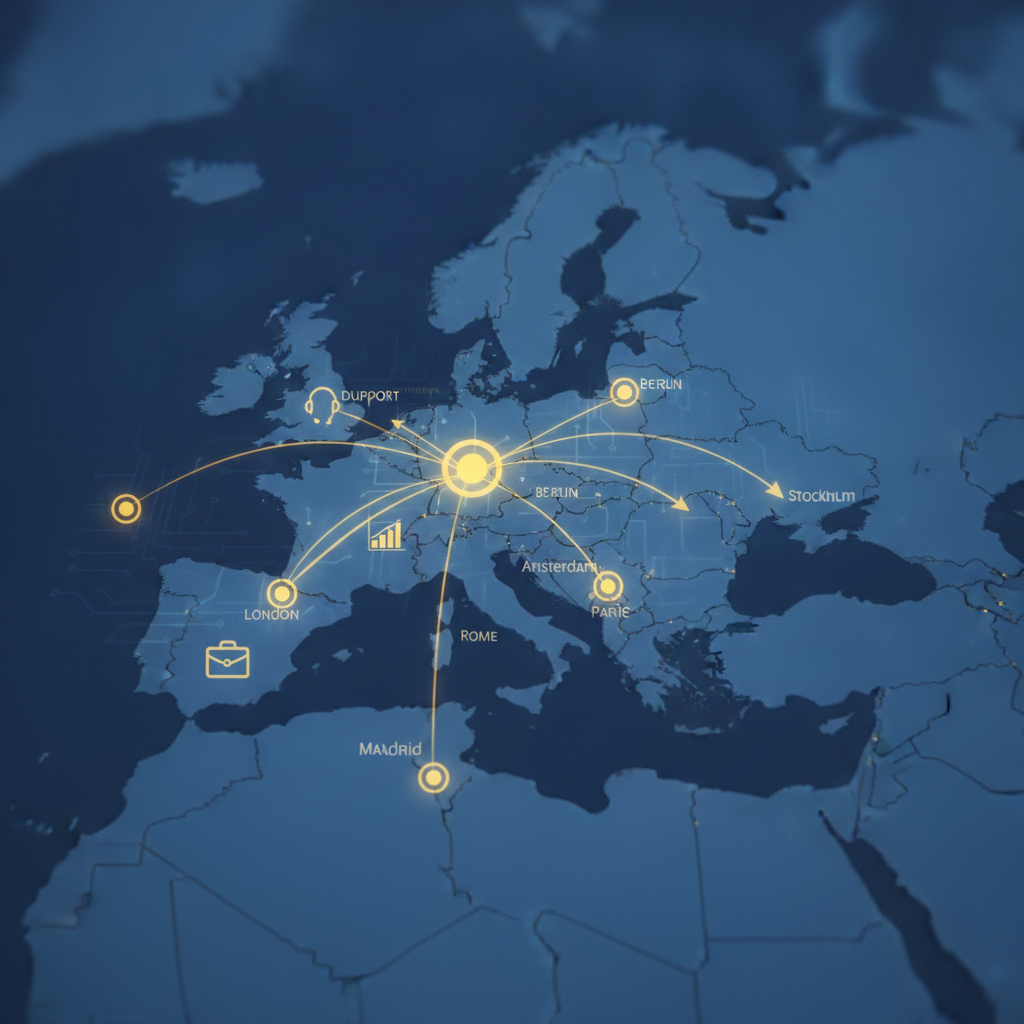
OpenAI just mapped how AI is reshaping job transitions across the EU. Here’s what it means for leaders and operators—and the first moves to make now.
What the OpenAI analysis says (in plain English)
- AI changes tasks within many jobs and nudges workers toward adjacent roles rather than causing sudden, mass displacement.
- Productivity gains appear where AI augments cognitive work—documentation, analysis, customer support, and coding—freeing time for higher‑value tasks.
- Transitions are smoother when workers have access to targeted reskilling and clear internal pathways into AI‑complementary roles.
- Firms that pair AI tools with process redesign—not just “tool drops”—capture outsized benefits.
Source: OpenAI’s “Mapping AI job transitions in the EU”.
Who feels the shift first
- Knowledge work: operations, finance, HR, marketing, legal research—routine analysis and drafting accelerate with AI.
- Customer support and service ops: higher deflection, faster resolution, and more complex cases handled by people.
- Data-heavy roles: analysts and planners spend less time on prep, more on modeling, scenario design, and decisions.
- Lower exposure (for now): work with high physical dexterity, on-site manual tasks, and roles requiring deep interpersonal presence.
Your 90‑day action plan
- Map task exposure, not just job titles: list top 10 recurring tasks per role; flag those suited to AI assist (summarization, drafting, retrieval, QA).
- Run targeted pilots: pick 2–3 processes with measurable pain (e.g., support macros, RFP drafts, month‑end notes) and baseline the metrics.
- Pair tools with SOPs: define when to use AI, prompt templates, review checklists, and escalation rules.
- Upskill by adjacency: move people from adjacent roles into AI‑complementary work with short, scoped learning paths.
- Create an internal talent marketplace: advertise AI‑augmented gigs (e.g., “customer insight synthesis”) to redeploy capacity.
- Measure and reinvest: track time saved, quality lift, and error rates; plow gains into training and process improvements.
- Set guardrails: confidentiality, citation standards, and human‑in‑the‑loop for high‑risk outputs.
Practical upskilling paths (by role)
- Customer Support → AI‑assisted Resolution Specialist: prompt chains for troubleshooting, knowledge search, sentiment handling, and compliance notes.
- Operations Analyst → Automation & Insights Partner: data extraction, RAG retrieval, scenario prompts, and basic scripting.
- Marketing Coordinator → Content Ops Manager: brand‑safe prompt libraries, A/B testing, and attribution hygiene with AI‑generated variants.
- Finance Associate → Narrative & Controls Lead: variance explanations, policy‑aware drafting, and formula/code review with AI.
- HR Generalist → Talent Intelligence Partner: JD generation, skills tagging, internal mobility matching, and bias checks.
Metrics to watch
- Cycle time: draft and resolution time per task/process.
- Quality: error rates, factuality/citation compliance, and rework.
- Throughput: tickets or documents closed per FTE.
- Transition velocity: percent of staff completing an AI learning path and moving into adjacent roles within 90–180 days.
- Employee sentiment: confidence using AI and perceived career mobility.
Risk and governance
- Data protection: use approved connectors; disable training on sensitive data; apply retention policies.
- Documentation: store prompts, system instructions, and decisions for audits.
- Model choice: match model to risk profile; add retrieval and validation for regulated content.
- Human oversight: require review for financial, legal, safety, and customer‑impacting outputs.
Key takeaway
Treat AI as a task‑level shift, not a job‑level shock. Map tasks, pilot fast, reskill by adjacency, and measure relentlessly—this is how you turn disruption into mobility.
Want more practical AI playbooks? Subscribe to our weekly newsletter: theainuggets.com/newsletter.
