



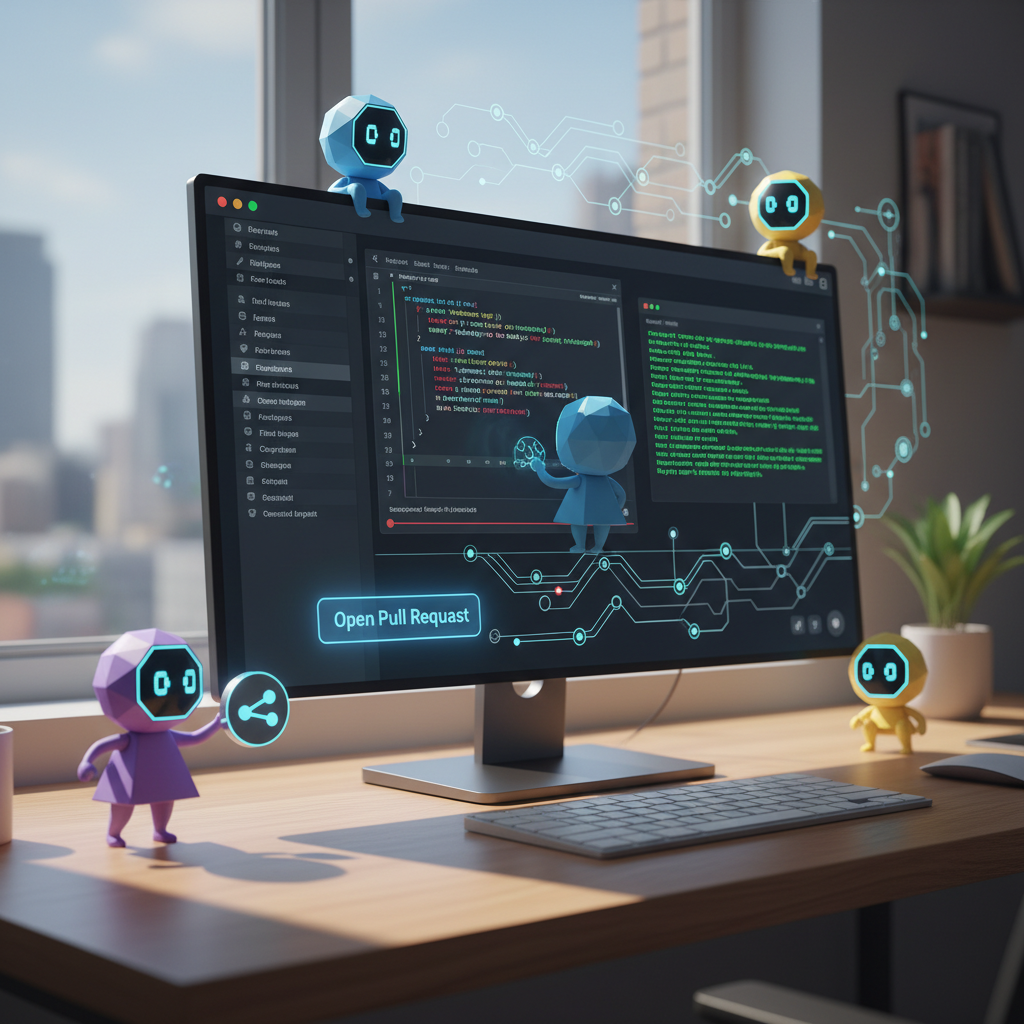
GitHub’s new “Squad” approach brings coordinated AI agents into your repository to plan changes, modify code, run tests, and open PRs—with you in the loop.
Source: GitHub Blog – How Squad runs coordinated AI agents inside your repository.
What is Squad?
Squad is a multi-agent system designed to operate inside your codebase. Instead of one general LLM doing everything, specialized agents collaborate—each focused on planning, coding, reviewing, and validating changes.
- Planner: turns an issue or goal into a step-by-step plan across files.
- Coder: edits or creates files with contextual awareness of your repo.
- Reviewer: critiques diffs, suggests fixes, and enforces style/constraints.
- Verifier: runs tests/linters and checks acceptance criteria before proposing a PR.
Why this matters for engineering teams
- Fewer context gaps: agents reason over your actual repo, not just pasted snippets.
- Safer changes: output is proposed as branches/PRs that keep humans in control.
- Higher leverage: routine fixes, refactors, and doc updates move faster.
- Better rigor: verification agents run checks before asking for your review.
How Squad works (at a glance)
- Ingest context: read key files (README, code, tests) to ground the task in your repo.
- Plan first: create a multi-step plan that maps goals to specific files and changes.
- Make changes: apply diffs, create new files, and update tests as needed.
- Verify: run unit tests/linters, iterate on failures, and ensure acceptance criteria.
- Propose: open a branch and PR for human review, with a summary of what changed and why.
For architecture details and examples, see the GitHub Blog deep dive. For broader context on multi-agent patterns, explore Microsoft’s AutoGen and the survey LLM-powered Multi-Agent Systems.
Get your repo ready for multi-agent coding
- Strengthen tests: prioritize fast, deterministic unit tests and clear acceptance criteria.
- Clarify intent: tighten READMEs, docs, and CONTRIBUTING to reduce ambiguity.
- Improve structure: favor small, cohesive modules and consistent style for easier edits.
- Instrument CI: ensure linters, type checks, and tests run reliably in PRs.
- Use templates: provide crisp issue and PR templates with expected outcomes.
Risks and guardrails to keep on
- Hallucinations: require passing tests and reviewer sign-off before merging.
- Security: block secrets in logs, run agents in sandboxed environments, and enforce least privilege.
- Quality drift: pin tool versions and enforce style/type checks in CI.
- Governance: set branch protections and code owner reviews for sensitive areas.
Quick start checklist
- Add or fix a minimal, fast test suite in your repo.
- Write a one-paragraph problem statement with acceptance criteria.
- Tag files or directories relevant to the task in the issue.
- Enable CI checks for tests, lint, and types.
- Review the PR diff and prompt the agents with clarifications if needed.
Takeaway
Multi-agent coding is most effective when your repo is testable, documented, and well-structured. Prepare the ground, keep humans in the loop, and let Squad handle the grind.
Get practical AI nuggets in your inbox—subscribe to our newsletter: theainuggets.com/newsletter.
