



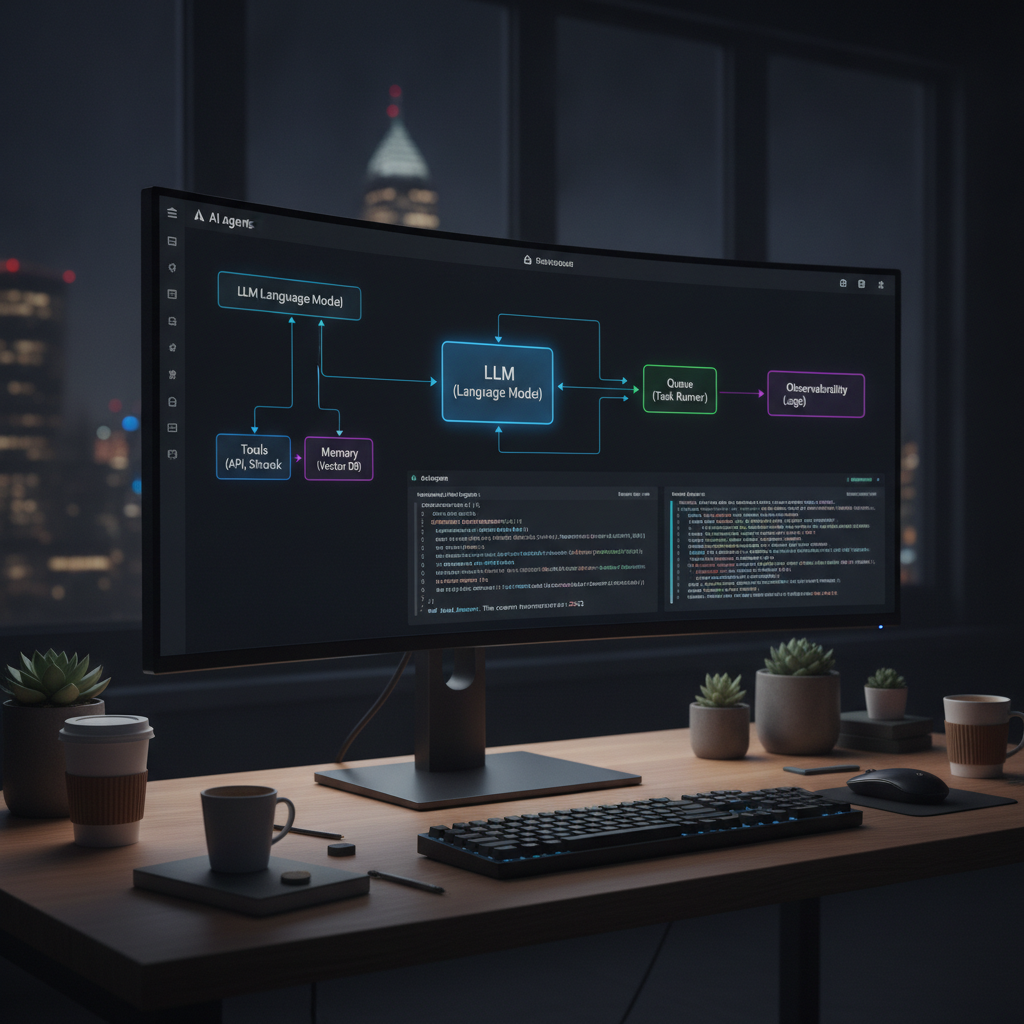
Vercel Agents signals a shift: agents aren’t demos anymore—they’re software. Here’s the practical stack, patterns, and pitfalls to ship agents that actually work.
This guide distills insights from Latent Space’s deep dive on Vercel Agents and pairs them with hands-on tips for teams building with Next.js and the Vercel AI SDK.
Source: Latent Space: Vercel Agents = New Software
What “Vercel Agents” actually means
Agents are event loops that use tools to achieve goals under constraints. Vercel productizes the loop with a runtime, SDKs, and observability so you can ship fast.
Think: plan → call tools → observe → iterate, with memory, retries, and guardrails—deployed on serverless/edge and wired to your UI.
The Vercel agent stack (cheat sheet)
- Core runtime and loop control: Vercel AI SDK for tool calling, multi-turn state, and streaming events.
- Provider abstraction and cost control: AI Gateway for key management, caching, rate limits, and model switching.
- Short- and long-term memory: Vercel KV for session state; Postgres for durable state; Vector for retrieval.
- UI and streaming UX: Next.js (RSC) with server actions; token-by-token streaming for fast feedback.
- Background work: scheduled tasks via Cron Jobs (e.g., sync KBs, refresh indices).
- Observability and evals: logs/traces via Vercel Observability; add structured outputs for easy validation and scoring.
- Security and governance: model/route allowlists via Gateway; redact or hash sensitive data in prompts and logs.
When to use it
- You’re a JS/TS and Next.js team shipping UI + agent workflows fast.
- You need multi-model flexibility, caching, and centralized keys.
- You want integrated storage, deployment, and monitoring without bespoke infra.
Skip or split workloads if you need long-running CPU/GPU jobs; offload heavy tasks to background workers or external inference endpoints.
Reference architecture
- Edge/serverless function hosts the agent loop.
- AI Gateway routes to the best model with caching and rate limits.
- Tools wrap your APIs (search, DB read/write, Slack, Stripe, internal services).
- Session memory in KV; durable state in Postgres; retrieval via Vector.
- Next.js streams partial results to the client; UI shows tool traces.
- Cron refreshes knowledge sources; alerts on failures/timeouts.
Build it in 5 steps
- Define the job to be done. Make tools deterministic, idempotent, and permissioned.
- Choose models via AI Gateway for portability; enable response caching where safe.
- Implement the loop with the AI SDK; cap recursion, add timeouts, and explicit stop conditions.
- Persist state: KV for conversations; Postgres for tasks/jobs; Vector for context retrieval.
- Instrument everything: structured outputs, traces, and automatic retries with jitter.
Cost and latency tips
- Stream early and often; render partials to reduce perceived latency.
- Use smaller context windows with retrieval; prune history aggressively.
- Batch tool calls and validate inputs to cut wasted tokens.
- Turn on Gateway caching for static or semi-static generations.
- Prefer JSON/objective formats to reduce back-and-forth.
Risks and guardrails
- Tool hallucination: require schema validation and explicit tool selection.
- Error storms: design idempotent tools; add circuit breakers and backoff.
- Data leakage: sanitize prompts/logs; encrypt secrets; watch PII in traces.
- Vendor lock-in: keep prompts and tools portable; use provider-agnostic routing.
Example: Tier‑1 support agent
- Intent: classify request; fetch relevant KB chunks via Vector.
- Resolve: suggest answer; if confidence low, create ticket via tool; post update to Slack.
- Escalate: hand off with conversation transcript and tool outputs in Postgres.
Use Gateway caching for common answers, stream suggested replies, and log tool traces for auditability.
Further reading
- Latent Space analysis: Vercel Agents = New Software
- Vercel AI SDK: sdk.vercel.ai
- AI Gateway: vercel.com/docs/ai/ai-gateway
- Storage: KV, Postgres, Vector
- Cron Jobs: vercel.com/docs/cron-jobs
Takeaway
Treat agents like software: define clear tools and stop conditions, persist state, route via a gateway, and observe everything. Ship small, iterate fast.
Like content like this? Subscribe to our free newsletter for weekly, actionable AI nuggets: theainuggets.com/newsletter
