



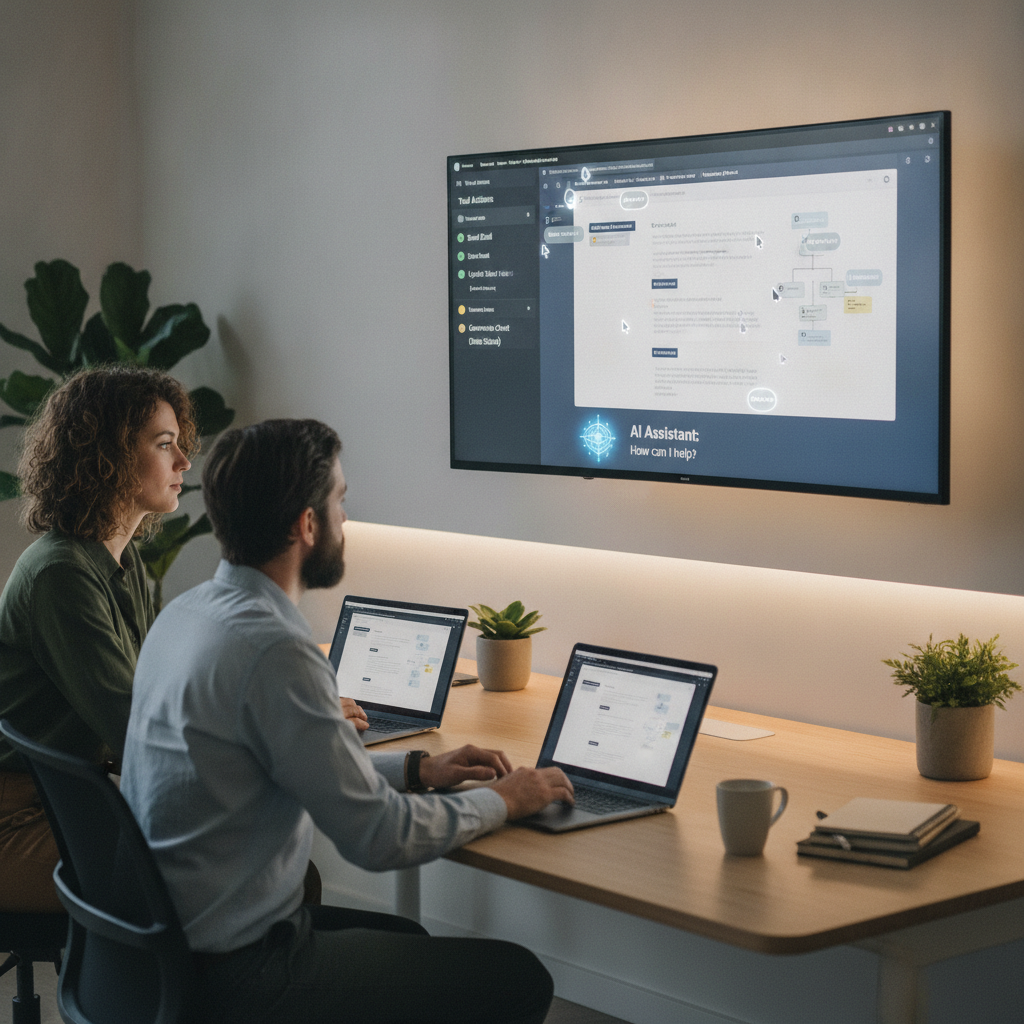
AI assistants are moving beyond single-user chat. The next wave is proactive, tool-using, and multiplayer—think Claude-style shared artifacts and agents that act with your OK.
This summary distills the strongest takeaways for builders from recent coverage by Latent Space (source) and vendor announcements.
The shift: chat to proactive, multiplayer
- Proactive assistance: Agents can watch relevant context (with clear consent) and suggest the next step—like drafting follow-ups or flagging anomalies—before you ask. See Google’s agent vision in Project Astra.
- Tool-native by default: Modern models call functions, browse, and control software. OpenAI’s GPT-4o Realtime and Anthropic’s Claude 3.5 Sonnet enable tight tool-use loops and live UI updates.
- Multiplayer artifacts: Shared canvases where the AI and humans co-edit code, docs, or data. Anthropic’s Artifacts model this pattern for collaborative generation and iteration.
What to build now
- Design triggers: Define when the agent may act (time, event, threshold) and always require an explicit user confirmation for high-impact steps.
- Expose safe tools: Provide function-callable APIs with strict schemas, rate limits, and granular scopes per user/workspace.
- Context pipelines: Index docs, tickets, CRM, and logs; retrieve only the minimum needed for each step to reduce error and cost.
- Multiplayer primitives: Shared workspaces, presence indicators, version history, and comment threads—just like Figma or Docs.
- Realtime UX: Stream tokens, partial results, and tool progress; allow users to interrupt, rewind, or hand off.
- Human-in-the-loop: Add review queues, reversible actions, and clear audit trails.
A minimal architecture that works
- Front end: Realtime chat + artifact canvas (docs, tables, code, or dashboards) with presence and commenting.
- Orchestrator: A graph-based agent runtime (e.g., LangGraph) to manage tools, retries, timeouts, and multi-actor flows.
- Models: Reasoning model (Claude 3.5/3.7 Sonnet) + multimodal/voice model (GPT-4o Realtime) + long-context model (Gemini 1.5) as needed.
- State + memory: Vector store for retrieval, KV store for session state, relational DB for artifacts and permissions.
- Safety + governance: Policy engine (who/what/where), content filters, red-team prompts, and immutable logs.
KPIs to prove value
- Task success rate and time-to-complete vs manual baseline.
- Interrupt accept rate: % of proactive suggestions accepted.
- Override rate: % of AI actions reversed by humans.
- Quality deltas: Fewer bugs, higher CSAT, better NPS on assisted tasks.
- Safety incidents: Blocks, escalations, or policy violations per 1,000 actions.
Takeaway
The winning pattern pairs proactive intelligence with tight safeguards and shared artifacts. Start small: one high-value workflow, one or two tools, clear triggers, and a great review loop.
Sources
- Anthropic: Claude 3.5 Sonnet and Artifacts
- OpenAI: GPT-4o Realtime
- Google: Project Astra
- Coverage: Latent Space: AI news on Claude, multiplayer, proactive
Enjoy bite-sized, practical AI insights? Subscribe to our free newsletter: theainuggets.com/newsletter
